
Few technologies are changing any therapy as quickly as pulsed field ablation (PFA) in the cardiac ablation market. Market intelligence firm GlobalData analysis reveals that PFA accounted for 20% of all electrophysiology (EP) ablation procedures in 2024 but by 2030 that figure is projected to jump to 75-80%. In 2025, the global market for PFA catheters was worth $3.4bn, accounting for just above 50% of the entire EP ablation market. In 10 years, PFA catheters will make up almost the entire market.
PFA creates cardiac lesions primarily through electroporation rather than the thermal mechanisms used in radiofrequency and cryoablation. That difference brings potential advantages in procedural speed and tissue selectivity, but it also creates a demanding engineering environment for the increasingly sophisticated sensing systems being incorporated into EP catheters.
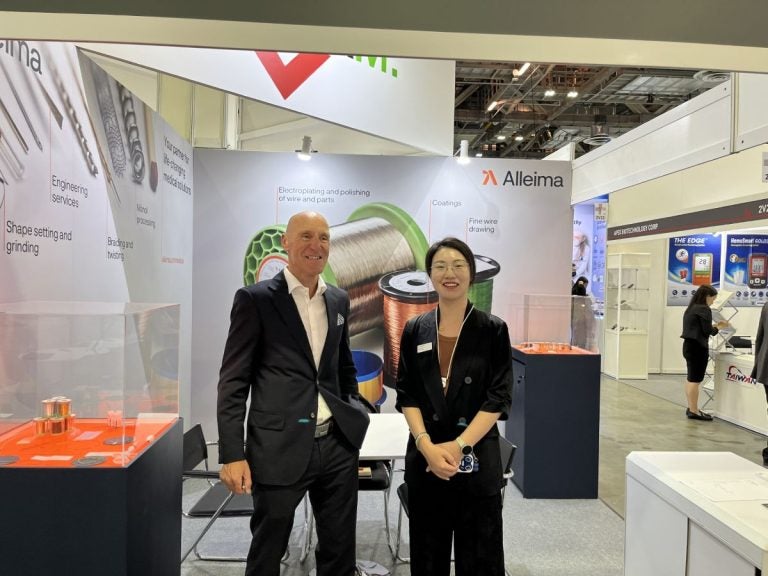
Here, Cacie McDorman, PhD, Global Product Manager – Wire Technologies at Alleima’s medical unit, discusses the engineering challenges involved in combining high-voltage energy delivery, real-time data and increasingly compact catheter designs.
Q: Why is sensing becoming such an important part of EP ablation catheter design?
Cacie McDorman (CM): The core signals are still surface electrocardiogram (ECG) and intracardiac electrograms because they are the foundation for rhythm diagnosis, mapping, pacing response and ablation endpoints. Pressure, impedance, temperature and imaging add important context. The newer areas we are watching are less about one specific signal and more about adding practical insight at the treatment site during PFA ablation procedures, such as tissue contact or proximity, local impedance or conductivity, distributed temperature, electro-mechanical motion, optical or ultrasound-based tissue information, and local field exposure.
From an Alleima wire-technology perspective, the opportunity is to support more sensing channels in smaller, fatigue-resistant designs while maintaining low-noise signal transmission, isolation and manufacturability.
Q: Does adding more sensors necessarily make a catheter better?
CM: The best combinations are the ones that help answer real procedural questions.
An electrogram (EGM) shows what the myocardium is doing; contact or proximity helps confirm whether energy is coupling into the tissue, impedance adds interface context, and imaging or mapping confirms whether the right area has been treated.
From a wire-technology standpoint, multimodal sensing usually means more conductors, more terminations and more insulation interfaces in the same or smaller device footprint.
Q: What makes sensor integration particularly challenging in PFA?
CM: PFA changes the sensor architecture quite a bit. Low-level EGM, pressure or temperature signals may sit in the same catheter, cable or connector ecosystem as high-voltage, microsecond-scale pulses.
That creates tougher requirements for dielectric strength, leakage control, grounding, shielding, filtering and signal recovery after pulse delivery. Sampling may need blanking windows around pulses, higher dynamic-range front ends, and post-pulse checks to make sure the sensor is reading tissue rather than artefact.
From a wire and coating standpoint, insulation quality, coating uniformity, pinhole control, conductor spacing, fatigue resistance and termination integrity become safety-critical design inputs, not commodity specifications.
Q: Is temperature sensing as important in PFA as it is in conventional ablation?
CM: Temperature is less useful as an efficacy endpoint in PFA than it is in RF ablation because the lesion mechanism is driven mainly by electroporation rather than controlled heating. That said, temperature still matters for safety, unintended thermal effects and dual-energy devices that combine RF ablation and PFA.
What becomes more important is confidence in tissue proximity, electrode contact, delivered electric field, electrode-tissue coupling, anatomic coverage and post-PFA electrogram interpretation. Impedance and field-related measurements may also become more valuable if they can separate good coupling from poor coupling. Imaging and mapping remain important because PFA success depends on coverage and field distribution, not just point temperature.
Q: If PFA is field based, how important is catheter contact?
CM: Contact still matters, but it needs to be interpreted differently than in RF ablation. In RF ablation, contact force is closely tied to heating and lesion formation. In PFA, the mechanism is electric field-mediated, so contact, proximity, electrode orientation, blood pool, tissue thickness and application count all influence field coupling.
Stable contact or close proximity gives more confidence that the field is reaching the intended tissue. Poor contact can waste pulses or leave gaps in coverage.
Q: How difficult is it to add these capabilities without making the catheter larger or harder to use?
CM: The trade-off is very real. Every sensor adds conductor count, insulation layers, terminations, stiffness, profile, assembly steps and potential failure modes.
A richer catheter can improve confidence and automate workflow, but only if it still tracks well, steers well, fits the sheath, handles fatigue and makes economic sense. OEMs will accept sensor richness when it is thin, integrated, robust and clearly tied to clinical decisions. They will reject it if it increases French size or makes the catheter feel worse in the physician’s hand.
This is where advanced wire design, coatings, cored conductors, multifilar constructions and good engineering can decide whether a sensing concept becomes a manufacturable device.
Q: At what point should manufacturability enter the design process?
CM: We need to think about manufacturability from the concept stage, not after the design is already locked. That means choosing wire constructions and material systems that can be drawn, coated, wound, welded, laser processed, bonded or terminated consistently at scale.
It also means planning how the sensor will be tested during production, including continuity, insulation resistance, dielectric strength, signal noise, tensile strength, fatigue, surface condition and sterilisation impact.
A sensing feature that works in a prototype but cannot survive downstream processing, handling, sterilisation, shelf life and high-volume assembly is not really a product yet.
Q: How should OEMs decide whether extra sensing is worth the additional complexity and cost?
CM: Customers are becoming very practical about this. Added sensing has value when it reduces uncertainty, shortens procedure time, improves lab throughput, reduces fluoroscopy or anesthesia time, lowers complication risk, improves first-pass success or reduces repeat procedures.
EP labs also look at training, operator variability and whether the technology helps standardise outcomes across physicians. The real test is whether the sensor changes the workflow in a useful way during the case. If it only creates more data without making a decision easier, it will be hard to justify the added cost.
Q: What does all this mean for the way OEMs work with component and materials suppliers?
CM: The biggest barriers are space, reliability and system integration. Every added sensor competes for space, insulation thickness, termination area and flexibility. Materials also have to work with electrodes, coatings, polymers, sterilisation, blood contact and long-term fatigue requirements.
In many cases, the toughest issues show up at the interfaces: sensor-to-wire, wire-to-connector, coating-to-metal and catheter-to-console. That is why early co-development between the OEM and supplier is so important.
Conclusion: OEM design priorities
Taken together, McDorman’s comments point to a broader development challenge for OEMs. PFA sensing has to add clinically useful information without compromising catheter size, handling, electrical safety or manufacturability. Early collaboration around wires, coatings, conductors, terminations and other interfaces can therefore be as important as the choice of sensor itself.
By partnering with a company like Alleima, global medical OEMs can benefit from their extensive experience in advanced alloys, metallurgical expertise and manufacturing highly specialized, custom-made wire-based solutions needed in PFA applications.
Find out more information about Alleima’s sensor integration solutions at their website www.alleima.com/sensing or download the whitepaper below.
Sources