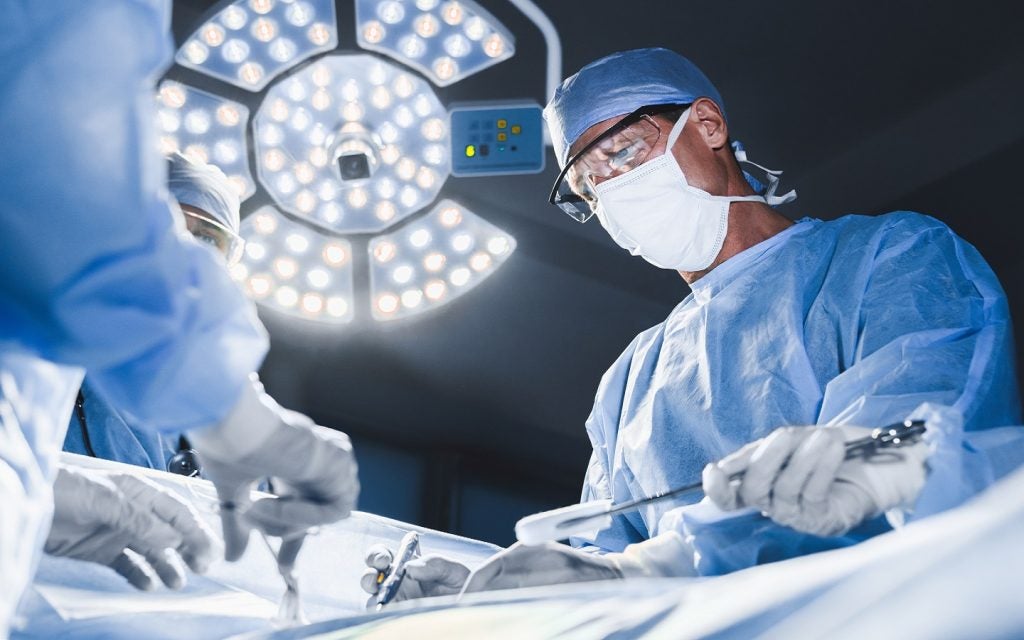
Minimally invasive therapies are entering a new development phase. An exciting area is energy therapies, which depend on delivering thermal or non-thermal forms of energy to a very specific tissue target while sparing everything around it.
Catheter-based electrophysiology (EP) ablation for treating cardiac arrhythmias is one prominent example of ablation therapy that is widely used and growing rapidly worldwide. The success of pulsed field ablation (PFA), a relatively new treatment that has proved to be much more safe than other energy-based treatments, such as radiofrequency (RF) ablation and cryoablation, has accelerated growth in this particular market.
PFA uses nonthermal electrical pulses and so greatly improves patient safety and reduces the potential trauma to neighbouring nerves, arteries and veins.
Data from GlobalData’s latest market model shows that PFA, was already worth $3.5bn in 2025 even though it had barely emerged from clinical trials just a few years before. The rapid adoption of PFA is also accelerating interest in dual-energy PFA/RFA catheters, which combine the safety advantages of PFA with the procedural versatility and established efficacy of RF ablation.
By 2035, GlobalData anticipates PFA to be a market worth $16.4bn, representing a 10-year CAGR of 16.9% cannibalising the EP market as existing therapies, such as radiofrequency (RF) and cryoablation fall out of favour.
The promise of catheter-based ablation therapy
Minimally invasive ablation therapy is also showing promise in adjacent cardiac therapies, such as transseptal procedures, as well as in treating other conditions. In oncology, it is being used to target cancer cells with either very hot or cold temperatures – and increasingly through newer techniques like irreversible electroporation (IRE) which uses electric pulses and histotripsy which uses focused ultrasound to mechanically break down tumours.
Renal denervation is an emerging solution in the treatment landscape for difficult-to-control hypertension. Meanwhile, ablation therapies are also used in gynaecology, which is effective at reducing or eliminating menstrual bleeding for many women with benign causes of abnormal uterine bleeding.
Other areas of clinical interest for ablation therapy are in certain lung procedures, particularly bronchial thermoplasty, which is used to treat severe asthma – and duodenal mucosal ablation, a minimally invasive endoscopic procedure that targets the thin surface layer of the duodenum to improve blood sugar control in people with type 2 diabetes.
This procedure, duodenal mucosal resurfacing (DMR), could transform type 2 diabetes treatment but is still in the clinical trial stage and has not yet reached widespread commercialisation. Yet several investigational approaches, including radiofrequency, laser and hydrothermal techniques, are showing early success in regenerating metabolically dysfunctional duodenal tissue in patients with insulin resistance.
In these therapies, physicians must rely on stable geometry and predictable and uniform energy-tissue interaction as visibility is limited, says Bhumi Panchal, digital marketing and event manager at Alleima, a global engineering and manufacturing partner of leading medical device innovators based in Sandviken, Sweden.
“It was this engineering challenge that Alleima, with its extensive capability and expertise in nitinol, originally had in mind to solve for. In DMR, a nitinol centering device can open and gently stabilise the duodenum while keeping the catheter centered, supporting more uniform treatment,” Panchal explains.
Panchal completed a thesis on this subject as part of her master’s degree. Research conducted as part of the thesis showed that the centering technology is a valuable solution in other therapies , where stability and consistency matter for uniform energy delivery – for example, in PFA, as outlined above.
“The nitinol alloy is well suited here because it’s flexible and super-elastic, which helps it conform to anatomy while minimising the risk of trauma,” Panchal says, then adds: “But if we look beyond DMR, this kind of centering or stabilising technology actually fits into several minimally invasive therapies across gastroenterology, heart, lungs and blood vessels.
“The body is compact, curved and constantly moving – whether from heartbeat, respiration, peristalsis, or pulsatile flow. If a therapy depends on uniform energy delivery around a circumference or consistent spacing from a wall, rather than ‘floating’ within the lumen, can translate into uneven treatment, variable outcomes, and procedural inefficiency”, Panchal concludes.
This challenge extends across a wide range of energy-based interventions, each with its own anatomical and procedural demands. In bronchial thermoplasty, for example, controlled heat is delivered inside the airways. Since the airways are narrow, curved, and branching, maintaining stable positioning becomes important to ensure the treatment is applied evenly and safely.
“Any variability in how the device sits against tissue can affect dose delivery and outcomes,” says Tom Schmid, global product manager for flexible instruments at Alleima.
So, with interest in procedures where physicians depend on fluoroscopy, mapping, and indirect imaging on the rise, increasing attention is being paid to centering technologies that can help stabilise devices, enable better visualisation, maintain predictable positioning, and support consistent energy delivery within some of the most difficult-to-reach areas of the human body.
Growing focus on nitinol for centering technology
Energy-based therapies have traditionally employed a variety of device architectures depending on the clinical application. In many procedures, such as cardiac radiofrequency ablation, physicians rely on steerable catheters, imaging, mapping technologies and tactile feedback to precisely position the treatment tip. In others, particularly where uniform circumferential treatment is required, balloons or other expandable structures have been used to stabilize the device within the anatomy.
While balloon designs are still used today, this approach has always had complexities – in the manufacturing process as well as with device reliability.
Balloons can also be vulnerable to damage, especially when the point of application needs to be moved and the ballon to be inflated several times.
With regards to PFA, for instance, some of the major OEMs have been turning to nitinol, a biocompatible alloy with “super-elastic” behaviour that allows devices to bend through tight curves and then recover shape.
“This helps with consistent positioning and can reduce the risk of unintended tissue trauma compared with stiffer metals, but it also enables a mechanically actuated centering ‘frame’ that expands and recaptures repeatedly, offering a robust pathway to consistent centering without balloon-style fluidics,” Schmid explains.
Nitinol’s super-elasticity allows the device to flex with constantly moving tissue while maintaining consistent, centralised contact against the treatment surface.
“The common theme is the same: you’re working inside narrow, curved, and often moving structures, and the outcome depends on how well the device is positioned and interacts with the surrounding tissue. This is where we see the real opportunity – not just in one procedure, but in enabling the next generation of minimally invasive therapies, Schmid adds.”
Manufacturing complexity requires specialised partnerships
While creating many advantages, nitinol remains significantly more difficult to process than stainless steel. Grinding, laser cutting and shape-setting all require highly specialised expertise, and small changes in alloy composition can dramatically impact the material behaviour and alter the device’s performance.
“Nitinol is not a material you just purchase and process,” Schmid explains. “You need deep expertise in shape setting and connecting the material to other components.”
For OEMs developing next-generation ablation and steerable targeting devices, these complexities underline the value of working with specialised partners. Alleima is among the firms supporting this shift, combining decades of nitinol-processing expertise with fine-wire manufacturing and vertically integrated production capabilities to enable complex component integration.
Partnerships with experienced materials and engineering specialists, such as Alleima, are becoming increasingly important for OEMs seeking to reduce development risk, accelerate time-to-market, and deliver the repeatable precision required for advanced minimally invasive therapies.
Read more about Alleima’s expertise in medical engineering and medical wire innovation in the whitepaper below.