Nitinol, a nickel-titanium alloy known for its unique combination of super-elasticity and shape memory, has become one of the most versatile materials in medical device design, enabling flexible, responsive tools that can adapt to the body’s most complex anatomies.
Despite its versatility, nitinol is notoriously difficult to handle in manufacturing, requiring highly specialised processing, precise temperature control, and advanced joining techniques. This is an area where Alleima, a specialist in advanced metallurgy and state-of-the-art nitinol-based instruments as well as medical wire manufacturing technologies, has built extensive expertise.
Why nitinol is reshaping catheter and retrieval device design
Historically, nitinol’s role in medical technology was relatively limited, with early use cases centred on guidewires. Tom Schmid, global product manager at Alleima, explains how this has changed: “If you look back, nitinol started as a passive material used in guidewires to guide other devices. Today, it has become an active material used in baskets, graspers and increasingly in steerable instruments, including those integrated into robotics.”
To understand nitinol’s evolving role, you must understand its unique and versatile capabilities. The uniquely defining properties super-elasticity and shape memory underpin why nitinol is increasingly applied in even more delicate instruments and thereby enabling applications at a new level of minimal invasiveness.
Compared with stainless steel, nitinol is eight to 12 times more elastic and can endure far greater strain, making it suitable for navigating tortuous anatomical pathways. Nitinol’s shape memory effect is based on a temperature-driven phase transformation between martensite (low temperature and easily deformed) and austenite (high temperature and shape-stable). When it is deformed in its low-temperature state and then heated above the specific transition temperature, it returns to its “set” shape. In medical devices, this transition temperature is often engineered to sit around body temperature, so the transformation happens naturally once the device is inside the body.
Nitinol’s impact on neurovascular and cardiovascular interventions
Some of the most significant value creation for nitinol is in cardiovascular and neurovascular interventions. These areas demand extreme precision and flexibility due to the delicate nature of the anatomy.
“In neurovascular procedures, nitinol instruments enable clot retrieval to prevent strokes. Without this material, many of these applications would not be feasible,” Schmid explains.
Prior to the adoption of nitinol, catheter and retrieval devices were largely constrained by the mechanical limitations of materials such as stainless steel. While strong and relatively easy to manufacture, these materials lacked the flexibility and elastic recovery. This meant that devices were more prone to kinking or permanently deforming, reducing control and reliability during procedures. In retrieval applications, the instruments often struggled to conform to irregular shapes, limiting capture efficiency and increasing the risk of tissue trauma.
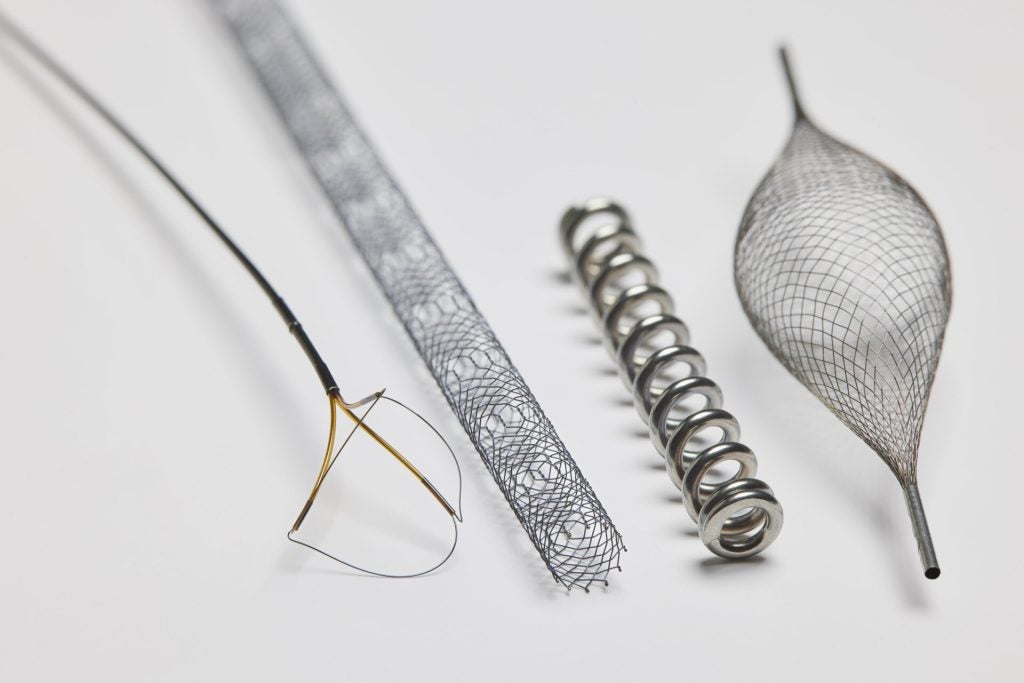
Nitinol enables highly compact retrieval structures, such as baskets and snares, to be constrained within low-profile catheter systems and then reliably expand at the point of use. This is critical in procedures where access is limited by vessel diameter or anatomical complexity, such as neurovascular and peripheral interventions. The material’s consistent force profile ensures that expansion and retraction can be precisely controlled, reducing the risk of incomplete capture or distal embolisation.
Improving success rates in thrombectomy and stone retrieval in urology
Retrieval devices must also balance the need for sufficient radial force to secure objects (such as clots or stones) with the need to avoid damaging the vessel. Nitinol’s super-elastic behaviour allows devices to conform to irregular geometries while maintaining gentle, uniform contact. This has contributed to improved first-pass success rates in thrombectomy and more efficient stone retrieval in urology, resulting in shorter procedure times and reducing the likelihood of repeat interventions. As catheter and retrieval systems continue to miniaturise, these material properties are becoming increasingly central to both device performance and clinical outcomes.
Furthermore, the catheters themselves are reliant on nitinol to achieve the flexibility and control required in these procedures. The material enables shafts and distal tips that can navigate highly tortuous vascular pathways while maintaining structural integrity and responsiveness. This is particularly important in neurovascular access, where catheters must traverse narrow, fragile vessels without causing trauma, while still providing the stability needed for precise device delivery and retrieval.
Torque transmission is a key advantage for nitinol, enabling near one-to-one transfer of rotational movement from the proximal to the distal end of a device. This provides clinicians with enhanced tactile feedback and control, which is particularly important when navigating the brain’s microvasculature or capturing objects in uneven anatomical circumstances.
“With nitinol, you can perform much more precise work. This reduces complications and the need for follow-up procedures,” says Schmid. Resulting in fewer repeat interventions, faster patient recovery and improved resource utilisation within healthcare systems. Consistent force profiles also reduce operator fatigue and support increased and more durable performance during complex procedures.
What’s next for nitinol in catheter and retrieval technologies
Nitinol’s role is set to expand further as device innovation converges with digital technologies, including the integration of sensors into nitinol-based instruments. These capabilities could enable real-time feedback during procedures, improving safety and decision-making for areas of the human body where real time condition definition not used to be thought about. Active steering is another area of development, going beyond simple opening-and-closing mechanisms. Future devices are expected to incorporate controlled distal-tip movement, enhancing first-pass success rates in retrieval and placement procedures.
Nitinol’s journey from a guidewire material to an enabler of complex, multifunctional devices is part of a broader transformation in medical technology.
With ongoing advances in processing, integration and design, nitinol’s role is likely to expand, supporting a new generation of minimally invasive surgery tools that are smarter, more responsive and increasingly tailored to individual patient needs. As Schmid summarises, the evolution is ultimately about capability: “Nitinol allows us to achieve applications that would simply not be possible with other materials.”
Despite these advantages, nitinol processing is significantly more complex than with conventional materials. According to Schmid: “Nitinol is much more sensitive in processing. Slight deviations in material composition or temperature deviations can immediately affect its behaviour and required treatment during manufacturing.”
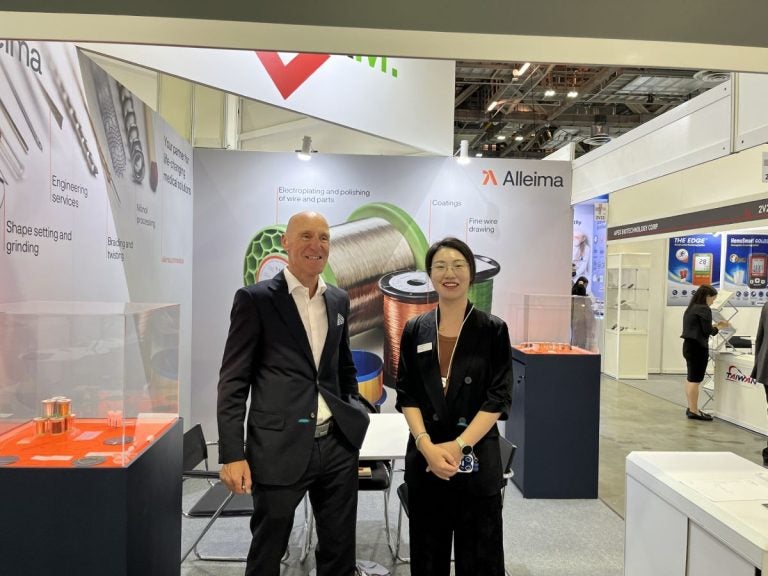
For OEMs, these complexities stress the importance of working with specialised partners. With a limited number of qualified suppliers and tight process windows for shape-setting, joining and surface treatment, consistency and reliability are critical to performance and regulatory compliance. One of these partners is the Swedish engineering company Alleima, which brings decades of nitinol processing expertise, wire manufacturing capabilities and vertical integrated instruments manufacturing to complex component integration.
As innovation in catheter and retrieval systems accelerates, partnering with experienced global engineering and materials specialists is becoming a strategic requirement for OEMs looking to reduce development risk, shorten time to market and ensure repeatable clinical outcomes.
To find out more about Alleima and its expert capabilities with nitinol, download the whitepaper below.