
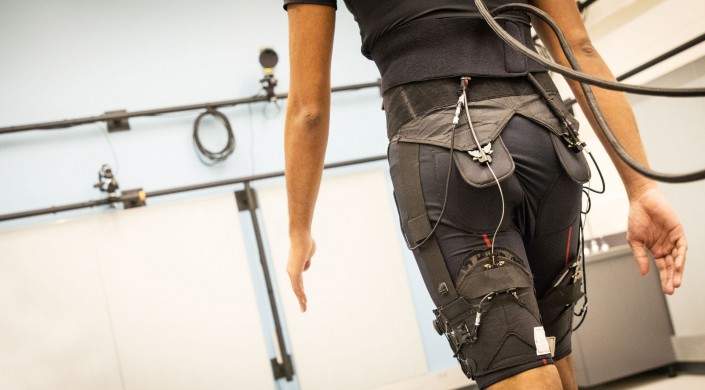
Researchers have produced a machine learning algorithm that can measure the movements of individual human bodies to help develop personalised, wearable exosuits.
The research was published in the paper ‘Human-in-the-loop optimization of hip assistance with a soft exosuit during walking, in Science Robotics. The researchers from the Harvard John A. Paulson School of Engineering and Applies Sciences (SEAS) and the Wyss Institute for Biologically Inspired Engineering identified ‘control parameters’ as one of the critical, but awkward variables involved in designing exosuits.
Go deeper with GlobalData


Discover B2B Marketing That Performs
Combine business intelligence and editorial excellence to reach engaged professionals across 36 leading media platforms.
“Before, if you had three different users walking with assistive devices, you would need three different assistance strategies,” said Myunghee Kim, postdoctoral research fellow at SEAS and co-author of the paper.
“Finding the right control parameters for each wearer used to be a difficult, step-by-step process because not only do all humans walk a little differently but the experiments required to manually tune parameters are complicated and time consuming.”
The team’s algorithm, however, can observe an individual’s walking pattern and make adjustments to their control parameters as they move, dramatically improving the efficiency and accuracy of these calculations. Individuals were given exosuits and observed by the software, which then calculated their control parameters, and applied force to specific areas of the body to reduce the metabolic cost – a measure of the inefficiency of a person’s walking motion – of those individuals.
Those who walked with a suit while under the influence of the algorithm reduced metabolic cost by 17.4% compared to those who walked with just an exosuit. This is also an improvement of more than 60% compared to the team’s previous work, published in 2017 in PLOS One.
US Tariffs are shifting - will you react or anticipate?
Don’t let policy changes catch you off guard. Stay proactive with real-time data and expert analysis.
By GlobalData“With wearable robots like soft exosuits, it is critical that the right assistance is delivered at the right time so that they can work synergistically with the wearer,” said John L. Loeb Associate Professor of Engineering and Applies Sciences Conor Walsh.
“With these online optimisation algorithms, systems can learn how to achieve this automatically in about 20 minutes, thus maximising the benefit to the wearer.”



