
Establishment Labs®, a global medical technology company dedicated to improving women’s health and wellness in breast aesthetics and reconstruction, has won Innovation and Safety awards for its Motiva Flora® SmoothSilk® Breast Tissue Expander in the 2025 Medical Device Network Excellence Awards for their advancements in breast reconstruction technology. This dual recognition underscores the company’s commitment to delivering meaningful innovation while maintaining the highest standards of patient safety in breast reconstruction.
The Medical Device Network Excellence Awards honor the most significant achievements and innovations in the medical device industry. Powered by GlobalData’s business intelligence, these Awards recognize the people and companies leading positive change and shaping the future of the industry.
Go deeper with GlobalData


Discover B2B Marketing That Performs
Combine business intelligence and editorial excellence to reach engaged professionals across 36 leading media platforms.
Establishment Labs® won the Innovation award in the Breast Reconstruction Devices category for introducing novel features that enhance clinical outcomes and streamline surgical procedures. Motiva Flora® also received the Safety award for implementing design elements that significantly reduce patient risks and improve overall implant safety.
This dual-category win establishes Motiva Flora® as a benchmark in both innovation and safety within breast reconstructive surgery.
Motiva Flora® represents Innovation in breast reconstruction devices: Magnet-free, MR Conditional design and advanced surface technology

The Motiva Flora® Tissue Expander distinguishes itself through a series of technological advancements that directly address persistent challenges in breast reconstruction. Most notably, it is the first and only breast tissue expander1 to feature a magnet-free, MR Conditional design.2 This innovation allows patients to safely undergo MRI scans at both 1.5 and 3 Tesla2, which is not possible with traditional expanders containing magnetic ports.1,2 Conventional expanders can cause significant MRI artifacts, signal loss, and even pose safety risks such as device displacement or overheating.1-4 By eliminating magnetic components, the Motiva Flora® enables susceptibility artifact-free imaging, supporting accurate diagnosis and ongoing monitoring for patients who may require MRI during the tissue expansion process.1,3,4

A further innovation is the integration of a passive RFID-enabled port system. Unlike magnetic port expanders, which require manual palpation or external magnets to locate the injection site, the Motiva Flora® uses a non-invasive electronic Port Locator.5,6 This device interacts wirelessly with the expander’s RFID coil, providing real-time visual feedback to precisely identify the injection dome.4-6 This not only streamlines the clinical workflow—reducing procedure time and minimizing patient discomfort—but also enhances safety by lowering the risk of accidental misinjection or tissue trauma.4
The expander’s SmoothSilk® surface technology is another key differentiator. Developed using a reverse mandrel imprinting technique, this bioengineered surface features a controlled surface architecture with an average roughness of 4 microns.5,6 Scientific studies have demonstrated that this architecture reduces the formation of fibrotic capsules7,8, lowers the expression of inflammatory cytokines, and promotes a more balanced immune response compared to traditional textured or smooth expanders.8 For example, histological analyses have shown significantly less fibrotic tissue and a unique immune cell profile around the SmoothSilk® surface, with lower levels of pro-inflammatory cells and higher levels of regulatory T cells.7,8 This translates to improved biocompatibility7 and a lower risk of complications such as capsular contracture.1
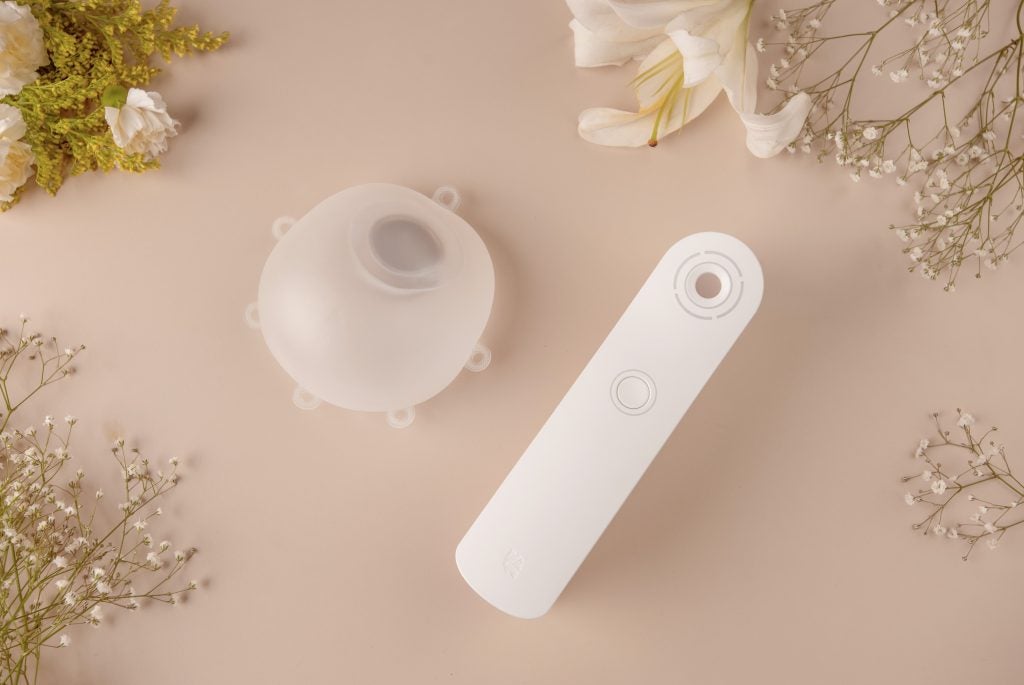
In terms of anatomical design, the Motiva Flora® features a tear-drop shape that more closely mimics the natural breast, with volume shifting to the lower pole during expansion.9 The proprietary TrueFixation® system, consisting of six reinforced silicone tabs (two tabs in the version commercially available outside the US), provides additional stabilization by securing the expander to adjacent tissue.5,6 This design helps maintain breast symmetry10 and prevents device displacement1,11, supporting more predictable and aesthetically pleasing outcomes.
Feedback from both surgeons and patients has been positive, with higher reported satisfaction scores for aesthetic results, comfort, and lower pole expansion compared to competitor devices.1,8 These outcomes reflect a patient-centered approach to innovation, addressing both clinical and quality-of-life considerations in breast reconstruction.
Implant safety: Infection control, imaging compatibility, and reduced complications
The Motiva Flora® Tissue Expander’s recognition in the Implant Safety category is underpinned by its comprehensive approach to minimizing risks associated with breast reconstruction. The SmoothSilk® surface plays a central role in infection control and biocompatibility.1,7,11 Its controlled surface architecture discourages inflammation, and bacterial attachment, which is a known risk factor for post-operative infections.7,12 Comparative studies have shown that surfaces with higher roughness or particulate debris can harbor more bacteria and provoke a stronger inflammatory response12,13, increasing the likelihood of complications such as capsular contracture or device explantation.1 In contrast, the SmoothSilk® surface has demonstrated reduced bacterial attachment12 and lower levels of pathogenic inflammation, as evidenced by both in vitro and in vivo analyses.

The device’s magnet-free, RFID-enabled port further enhances patient safety by eliminating the MRI-related hazards associated with traditional magnetic ports. Patients with magnetic expanders are often excluded from MRI diagnostics due to risks of port displacement, overheating, and significant image distortion.1-4 The Motiva Flora®’s MR Conditional labelling ensures that patients can safely undergo MRI scans under specified conditions,2-6 enabling timely detection of complications, assessment of the contralateral breast, or evaluation of pre-existing implants without the need for device removal or additional surgery.1,3,4
Another important safety feature is the expander’s compatibility with radiotherapy planning. Traditional expanders with metallic ports can cause CT imaging artifacts and radiation dose attenuation, leading to inaccurate treatment planning and potential underdosing of target tissues or overdosing of adjacent organs such as the heart and lungs.1,14,15 The Motiva Flora®’s RFID port, made from non-metallic materials, produces minimal imaging artifacts and allows for more precise radiation dose calculations.1,14,15 Clinical and phantom studies have demonstrated up to a 75% reduction in uncertainty1 and improved delineation precision during radiotherapy planning, which can contribute to better oncological outcomes and reduced toxicity to vital organs.1,14
Clinical data support the device’s safety profile, with lower rates of post-operative complications, explantation, and re-intervention compared to traditional expanders.1,11 For example, studies have reported a reduction in infection rates and a 0% explantation rate due to MRI needs.1 The Motiva Flora® also minimizes periprosthetic fluid accumulation and particulate debris generation, further reducing the risk of adverse events.8
Overall, the Motiva Flora® SmoothSilk® Tissue Expander offers a safety profile that encompasses biocompatibility,7 infection control,12 imaging compatibility,1-4 and patient comfort.8 These features collectively set a high standard for implant safety in breast reconstruction, addressing the complex needs of both clinicians and patients.
Juan José Chacón-Quirós, Establishment Labs Founder and Board Member said, “This recognition is a proud moment for all of us at Establishment Labs®. Receiving not one, but two Medical Device Network Excellence Awards for Motiva Flora®, in the categories of Innovation in Breast Reconstruction Devices and Implant Safety, is a powerful validation of our team’s relentless dedication to innovation and women’s health”.
“As we’ve participated in these awards for the first time, this milestone reflects not only the scientific and technological strength of our tissue expander, but also its meaningful impact on surgical outcomes, patient safety, and quality of life. Motiva Flora® is helping set a new standard in breast reconstruction, one that places women’s needs, safety, and confidence at the center of care.”
Company Profile

Establishment Labs Holdings Inc. is a global medical device company dedicated to improving women’s health and wellness in breast aesthetics and reconstruction through the power of science, engineering, and technology. The Company offers a portfolio of solutions for breast health, breast aesthetics, and breast reconstruction in over 90 countries. With over four million Motiva® devices delivered to plastic and reconstructive surgeons since 2010, the Company’s products have created a new standard for safety and patient satisfaction.
The company’s minimally invasive platform consists of Mia Femtech™, a unique minimally invasive experience for breast harmonization, and Preservé™, a breast tissue preserving and less invasive technology for breast augmentation, revision augmentation and mastopexy augmentation. GEM® is a next-generation minimally invasive system for gluteal ergonomic modeling currently undergoing an IRB-approved pivotal study.
The Motiva Flora® tissue expander is used to improve outcomes in breast reconstruction following breast cancer and is the only regulatory-approved expander in the world with an integrated port using radio-frequency technology that is MR Conditional. Zensor™ is an RFID technology platform used to safely identify implantable devices from outside the body, and includes the company’s first biosensor Zenº™, currently part of an IRB-approved pivotal study to measure core breast temperature. These solutions are supported by over 200 patent applications in 20 separate patent families worldwide and over 160 scientific and clinical studies and publications in peer-reviewed journals.
Establishment Labs manufactures at two facilities in Costa Rica, compliant with all applicable regulatory standards under ISO13485:2016 and FDA 21 CFR 820. For additional information, please visit www.establishmentlabs.com
Contact Details
Media Contact
Malavika William
E-mail: Mwilliam@Establishmentlabs.com
Links
Website:
https://establishmentlabs.com/
References:
- Clemens MW, Mitchell MP, Christensen JM, et al. MRI-Conditional Tissue Expanders in Breast Reconstruction: Clinical Outcomes and Radiation Therapy Implications. Plast Reconstr Surg. Published online February 11, 2025. doi:10.1097/PRS.0000000000012029
- Bayasgalan M, Munhoz AM, Shellock FG. Breast Tissue Expander With Radiofrequency Identification Port: Assessment of MRI Issues. American Journal of Roentgenology, 2020. 215(1), pp.159–164. doi:https://doi.org/10.2214/ajr.19.22492.
- Schiaffino S, Cozzi A, Pompei B, Scarano AL, Catanese C, Catic A, Rossi L, Del Grande F, Harder Y. MRI-Conditional Breast Tissue Expander: First In-Human Multi-Case Assessment of MRI-Related Complications and Image Quality. J Clin Med. 2023 Jun 30;12(13):4410. doi: 10.3390/jcm12134410.
- Clausen-Oreamuno C, Perez-Rodrigo S, Stillaert F, Tejerina A, Tejerina A, Shellock F. Benefits of Using Magnetic Resonance Imaging During Breast Tissue Expansion: Literature Review and Case Series, Aesth Surg Jour, 2023; sjad264, doi.org/10.1093/asj/sjad264
- Establishment Labs®. DDD-001007: Device Description Motiva Flora® SmoothSilk® Tissue Expander. June 2023. Internal Data on File, Establishment Labs.
- Establishment Labs®. DDD-008: Device Description Document For Motiva Flora® Tissue Expander. September 2023. Internal data on File. Establishment Labs.
- Doloff JC, Veiseh O, de Mezerville R, et al. The surface topography of silicone breast implants mediates the foreign body response in mice, rabbits, and humans. Nat Biomed Eng.. 2021;5(10):1115-1130. doi:10.1038/s41551-021-00739-4
- Schoberleitner I, Augustin A, Egle D, et al. Is It All about Surface Topography? An Intra-Individual Clinical Outcome Analysis of Two Different Implant Surfaces in Breast Reconstruction. J. Clin. Med. 2023, 12, 1315. https://doi.org/10.3390/jcm12041315
- Bletsis P, Bouwer L, Ultee K, Cromheecke M, van der Lei B. Evaluation of anatomical and round breast implant aesthetics and preferences in Dutch young lay and plastic surgeon cohort. J Plast Reconstr Aesthet Surg. 2018. 71(8), 1116-1122. doi: 10.1016/j.bjps.2018.04.010
- Khavanin N, Gust MJ, Grant DW, Nguyen KT, Kim JYS. Tabbed tissue expanders improve breast symmetry scores in breast reconstruction. Arch Plast Surg. 2014;41(1):57-62.doi:10.5999/aps.2014.41.1.57
- Limido E, Bonomi F, Guggenheim L, et al. First experience from 200 cases with a new breast tissue expander for multi-stage pre-pectoral breast reconstruction after mastectomy. Journal of Plastic, Reconstructive & Aesthetic Surgery. Published online June 2025. doi:https://doi.org/10.1016/j.bjps.2025.06.007
- James G, Boegli L, Hancock J et al. Bacterial adhesion and biofilm formation on textured breast implant shell materials. Aesth Plast Surg. 2019 Apr; 43:490–497. doi: 10.1007/s00266-018-1234-7
- Hallab NJ, Samelko L, Hammond D. Particulate debris released from breast implant surfaces are highly dependent on implant type. Aesthetic Surgery Journal, 2021; doi: 10.1093/asj/sjab051
- Hwang NH, Kim M, Lee NK, Lee S, Hwang J. Dosimetric effect of injection ports in tissue expanders on post-mastectomy volumetric modulated arc therapy (VMAT) planning for left-sided breast cancer. Applied Sciences. 2022, 12 (13), 6461. doi:10.3390/app12136461
- Matsubayashi F, Takahashi T, Miyauchi H, Ito Y, Harada A, Yoshioka Y. Modeling of a tissue expander with a radiofrequency identification port in postmastectomy radiation therapy planning. J Radiat Res Imaging. 2024. doi:10.1093/jrr/rrae004


