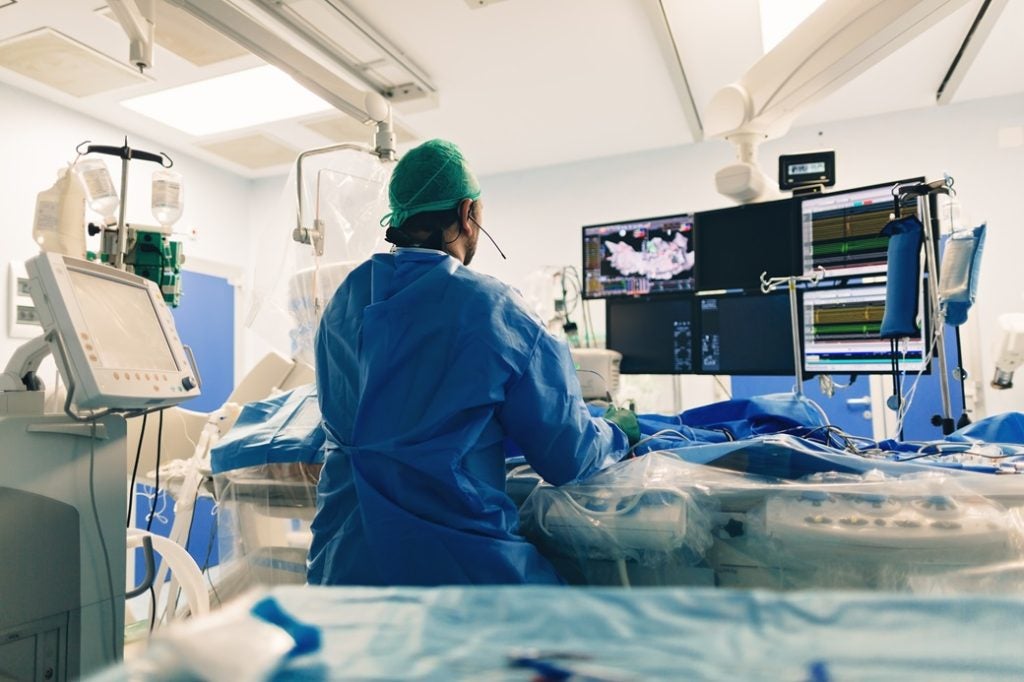
Electrophysiology (EP) ablation is a minimally invasive, typically curative procedure used to treat heart rhythm disorders (arrhythmias) by destroying the small, faulty electrical pathways in the heart causing the issue. It is applicable for a wide variety of arrhythmias and has a high success rate with low rates of complication and recurrence.[i]
As the at-risk population of heart disease grows and more people gain access to healthcare through medical tourism[ii], the global EP catheter market is expected to experience steady growth. Market intelligence firm GlobalData projects these medical instruments to grow at a compound annual growth rate (CAGR) of 11% in the decade between 2025 and 2035.
Within this treatment area, PFA has emerged as the newest technology for catheter ablation to treat cardiac arrhythmias, offering improvements in both procedure speed and safety.
“PFA uses high-voltage electrical pulses rather than thermal energy to destroy cardiac tissue and is rapidly reshaping atrial fibrillation treatment,” says Beata Blachuta, director, research and analysis, medical devices, GlobalData.
“Unlike conventional radiofrequency (RF) or cryo ablation, PFA can selectively target cardiac cells while reducing collateral damage to surrounding structures such as the oesophagus or phrenic nerve. It’s still very new right now and on average, the price of one PFA catheter is about $2,000 more than the average ablation catheter. However, physicians are still showing a strong preference for PFA catheters despite their much higher price point, and we believe that PFA catheters will increasingly cannibalise the traditional ablation catheters market.”
Ablation therapy potential outside cardiac procedures
Outside of cardiovascular treatment, renal denervation is an emerging solution in the treatment landscape for difficult-to-control hypertension, with growing clinical adoption across multiple global markets. Ablation therapy is also a common and effective approach for treating certain solid-tumour and organ-based cancers where localised tumour destruction is possible, while also effective at reducing or eliminating menstrual bleeding for many women with benign causes of abnormal uterine bleeding[iii].
a closely watched area for ablation therapy is duodenal mucosal ablation for Type 2 Diabetes. Several investigational approaches, including radiofrequency, laser and hydrothermal techniques, aim to regenerate metabolically dysfunctional duodenal tissue in patients with insulin resistance. Emerging evidence suggests these procedures may improve glucose regulation and reduce dependence on long-term medication.
For these therapies, precision is critical.
Energy delivery must remain consistent across the mucosal surface while avoiding injury to deeper tissue layers. That is why the nickel-titanium alloy nitinol is best to steer these catheters, explains Tom Schmid, global product manager at Alleima.
“In ablation and mucosal therapies, targeting accuracy depends on maintaining stable positioning against constantly moving anatomy,” explains Schmid. “Nitinol allows for that, ensuring the device remains consistently centred during therapy delivery while maintaining controlled contact with the treatment surface.”
Alleima is a trusted partner for leading medical device innovators and a specialist in processing nitinol-based medical components, instruments and implants. According to Alleima, the unique nickel-titanium alloy is increasingly central to innovating in steerable targeting devices, ablation catheters, and minimally invasive instruments, all designed to operate with acute precision in some of the body’s most delicate anatomy.
That ability to conform to anatomy while maintaining controlled positioning is becoming highly valuable as ablation therapies expand beyond cardiology into applications in gastrointestinal and metabolic disease and next generation targeting systems are increasingly being designed around active steering and distal articulation. Rather than relying solely on manual catheter manipulation, newer nitinol-enabled systems can provide controlled directional movement at the treatment site, improving first-pass positioning and reducing procedural adjustment time.
Schmid believes active steering will become one of the defining trends in the next five years: “We will see more movement at the distal tip of retrieval and targeting devices. That enables physicians to directly target their objective rather than performing repeated back-and-forth adjustments under X-ray.”
Improved first-pass accuracy could reduce procedure times and lower complication risks, particularly in cardiovascular and neurovascular interventions where targeting precision directly influences patient outcomes.
Nitinol is also becoming increasingly important in robotic-assisted intervention, where repeated mechanical motion places high fatigue demands on flexible catheter systems and steerable instruments. Beyond steerability, manufacturers are more frequently integrating sensing technologies into nitinol-based systems. Emerging devices include pressure-sensing guidewires, temperature-monitoring snares and smart stents capable of detecting flow changes or restenosis risk in real time.
Hybrid systems can improve procedural feedback while reducing unintended tissue damage during energy-based therapies.
Manufacturing complexity remains a barrier
Despite its advantages, nitinol remains significantly more difficult to process than stainless steel.
Grinding, laser cutting and shape-setting all require highly specialised expertise, and small changes in alloy composition can dramatically impact the material behaviour and alter the device performance.
“Nitinol is not a material you just purchase and process,” Schmid explains. “You need deep expertise in shape setting and connecting the material to other components.”
For OEMs developing next-generation ablation, mucosal and steerable targeting devices, these complexities underline the value of working with specialised partners. With a limited number of qualified suppliers and tightly controlled processes for shape-setting, grinding, braiding, joining, and surface treatment, consistency and reliability are essential to maintaining device precision, navigational control, and regulatory compliance. Alleima is among the firms supporting this shift, combining decades of nitinol-processing expertise with fine-wire manufacturing and vertically integrated production capabilities to enable complex component integration.
Partnerships with experienced materials and engineering specialists, such as Alleima, are becoming increasingly important for OEMs seeking to reduce development risk, accelerate time-to-market, and deliver the repeatable precision required for advanced minimally invasive therapies.
Read more about Alleima and its expert capabilities with nitinol in the whitepaper below.
[i] Catheter ablation for cardiac arrhythmias: A 14-year experience with 5330 consecutive patients at the Quebec Heart Institute, Laval Hospital – PMC
[ii] https://www.medicaltourism.com/articles/world-class-cardiovascular-surgery-destinations-abroad
[iii] https://pmc.ncbi.nlm.nih.gov/articles/PMC5779558/