
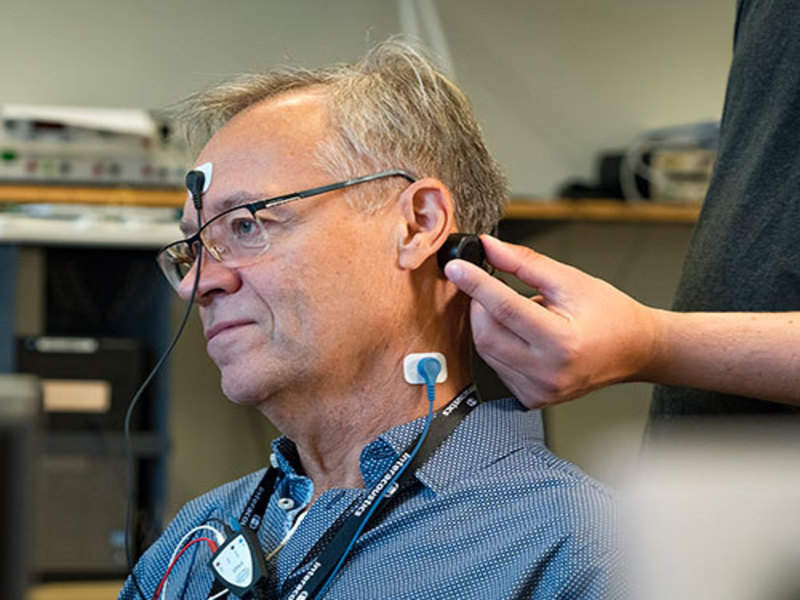
Scientists at Chalmers University of Technology in Sweden have developed a new vibrating device using bone conduction technology to diagnose dizziness.
The new testing device is designed to be placed behind a patient’s ear.
Go deeper with GlobalData


Discover B2B Marketing That Performs
Combine business intelligence and editorial excellence to reach engaged professionals across 36 leading media platforms.
Around 50% of adults above 65 suffer from dizziness and balance problems. However, existing tests to detect the causes of these problems are known to be painful and risk hearing damage.
The new vibrating device is said to offer significant advantages over the current tests.
The Vestibular Evoked Myogenic Potentials (VEMP) test is a commonly used approach. It involves the use of loud sounds to induce a muscle reflex contraction in the neck and eye muscles.
In contrast, the new vibrating device uses bone-conducted sounds. The device is small, compact and has been optimised to evoke the reflex at low frequencies such as 250Hz.
Bone conduction transmission takes place when sound waves transform into vibrations via the skull and stimulate the cochlea within the ear.
Chalmers University of Technology postdoctoral researcher Karl-Johan Fredén Jansson said: “Thanks to this bone conduction technology, the sound levels which patients are exposed to can be minimised. This eliminates any risk that the test itself could cause hearing damage.”
Additional benefits of the vibrating device include safer testing in children. Besides, the device can help in identifying the cause of dizziness in patients who already have impaired hearing due to certain ear conditions.
The device is compatible with standardised equipment for balance diagnostics and is expected to be comparatively less expensive.
A pilot study demonstrated that the new testing device can achieve VEMP thresholds at considerably lower hearing levels. The researchers are planning to conduct a larger study in alliance with Sahlgrenska University Hospital.


