
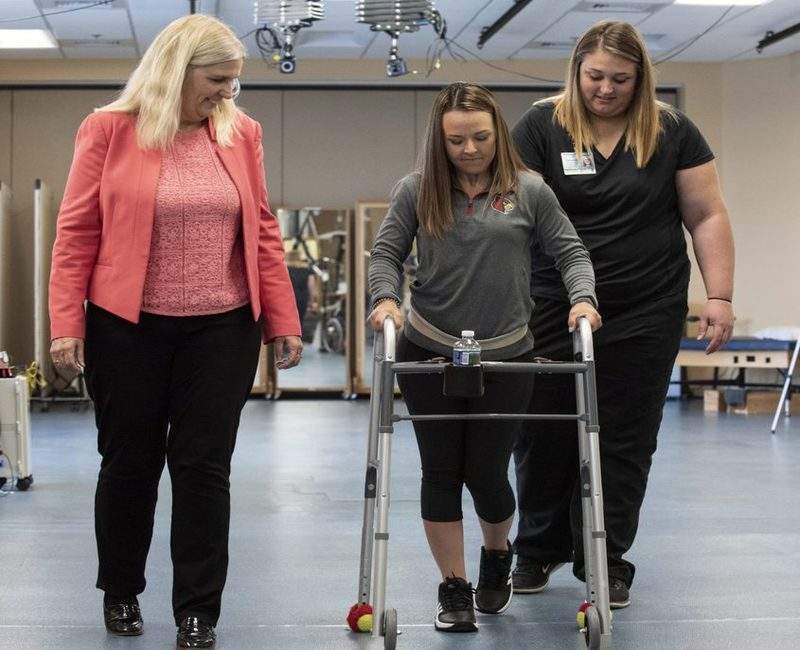
A small study conducted at Kentucky Spinal Cord Injury Research Center at the University of Louisville (UofL) in the US has showed that epidural stimulation and physical therapy can help regain some movement in paralysed patients.
Of the total four participants, two are able to walk over ground with assistive devices and all four achieved independent standing and trunk stability.
Go deeper with GlobalData


Discover B2B Marketing That Performs
Combine business intelligence and editorial excellence to reach engaged professionals across 36 leading media platforms.
All the patients were at least 2.5 years post injury and could not stand, walk or voluntarily move their legs prior to the study.
During the initial stages of the study, the participants underwent daily locomotor training for eight to nine weeks, following which they were implanted with an epidural stimulator.
The researchers observed that the combination of epidural stimulation and physical training could restore some brain-to-spine connectivity, allowing certain mobility when using the epidural stimulator.
Kentucky Spinal Cord Injury Research Center professor and associate director Susan Harkema said: “We must expand this research – hopefully, with improved stimulator technology – to more participants to realize the full potential of the progress we’re seeing in the lab, as the potential this provides for the 1.2 million people living with paralysis from a spinal cord injury is tremendous.”
Another study conducted by the Mayo Clinic in alliance with the University of California, Los Angeles (UCLA) yielded similar results in a paralysed man who was treated with the same approach.
The Mayo Clinic reported that after spinal cord stimulation and physical therapy, the patient regained the ability to stand and walk with assistance.
Epidural stimulation involves continuous electrical current application at different frequencies and intensities to specific locations on the lumbosacral spinal cord. This location is associated with the dense neural networks that largely control hips, knees, ankles and toe movement.
Meanwhile, locomotor training is intended to retrain the spinal cord to ‘remember’ the pattern of walking by repetitive practice of standing and stepping.


