
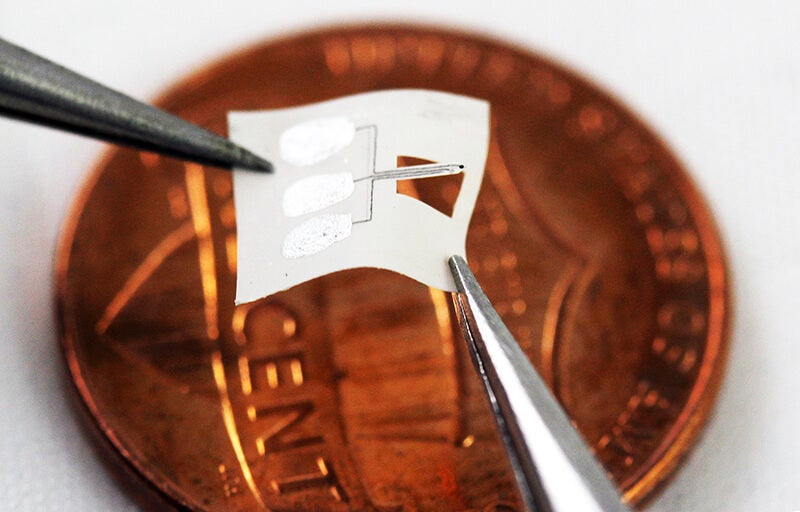
Researchers at Purdue University have created a sensor that could track glutamate, which is associated with neurological conditions such as migraines, Alzheimer’s and Parkinson’s.
Currently being used as a research tool for animal testing, the sensor is being developed to monitor drug responses as part of treatments for neurotrauma.
Go deeper with GlobalData


Discover B2B Marketing That Performs
Combine business intelligence and editorial excellence to reach engaged professionals across 36 leading media platforms.
Tracking glutamate levels has traditionally been considered difficult, hindering the development of new therapies. Previous devices have not been sensitive enough to detect the neurotransmitter, fast enough to track its increase or affordable enough for use in long-term projects.
Purdue University neuroscience and biomedical engineering professor Riyi Shi said: “When you feel like you’re running a fever, it doesn’t matter when you check your temperature, it will probably be the same for several hours.
“But a glutamate spike is so fast that if you don’t capture it at that moment, you miss the whole opportunity to get data.”
In-vivo measurement of glutamate levels would provide information on spinal cord injuries and the development of brain diseases.
Implanted on the spinal cord, the sensor is 3D-printed and laser-micromachined, enabling researchers to change its size, shape and orientation. This will enable it to carry out testing without the need for microfabrication.
Purdue University biomedical engineering assistant professor Hugh Lee said: “We wanted to create a low-cost and very fast way to build these sensors so that we can easily provide researchers with a means to measure glutamate levels in vivo.”
When tested in an animal model, the sensor was able to quickly capture spikes in glutamate. Current devices take 30 minutes.


