
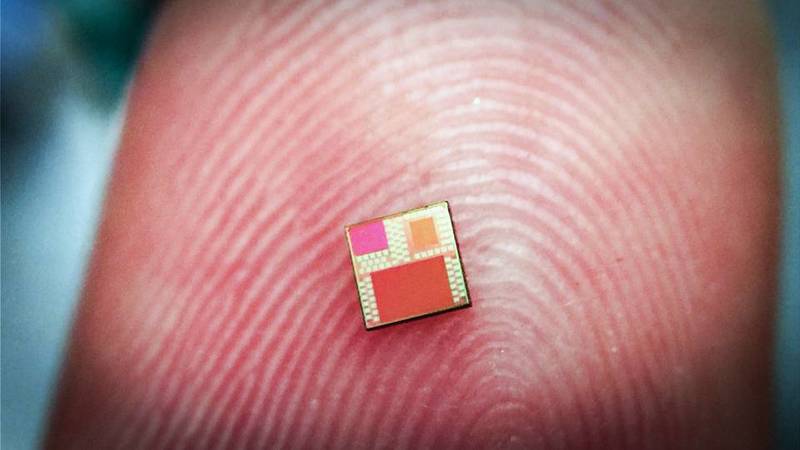
A research team at Princeton University has used silicon chip technology to develop a diagnostic device that is about the size of a grain of salt.
Silicon chips are commonly used as biosensors in computers and mobile phones. Made from tiny metal layers, the technology offers an alternative to complex and bulky optical instrumentation.
Go deeper with GlobalData


Discover B2B Marketing That Performs
Combine business intelligence and editorial excellence to reach engaged professionals across 36 leading media platforms.
Princeton University electrical engineering assistant professor Kaushik Sengupta said: “The key idea is to allow complex optical systems in modern-day chips. All smartphones carry a million-pixel camera. How do we turn this into a device that allows laboratory-quality diagnostics?
“We show these complex optical biosensor systems can also be realised in the same technology with absolutely no change in manufacturing the microchip.”
The team observed that microchips can be adapted to leverage light’s behaviour during interaction with structures that are smaller than a single wavelength. Such use of light is said to facilitate the detection of biological substances, including bacterial DNA.
Research published in the ACS Photonics and Biomedical Optics Express journal reported that the new sensor can detect molecules in samples with sensitivity comparable to that of diagnostic lab equipment.
The sensor uses chemical antibodies to identify targeted molecules. These are designed to react with a specific molecule and are altered to produce light at a specific wavelength when exposed to the target.
The team designed a testing plate with 96 antibody sensors. This plate was small enough to be embedded into the microchip.
Sengupta added: “What we have come up with here is just a low-cost, tiny fluorescent sensor, and you can use fluorescent sensing in many different things; for food and water-quality monitoring, environmental monitoring and industrial applications.”
The researchers hope that the new silicon chip technology will enable diagnostic systems embedded in a pill or deployed on a smartphone.


