
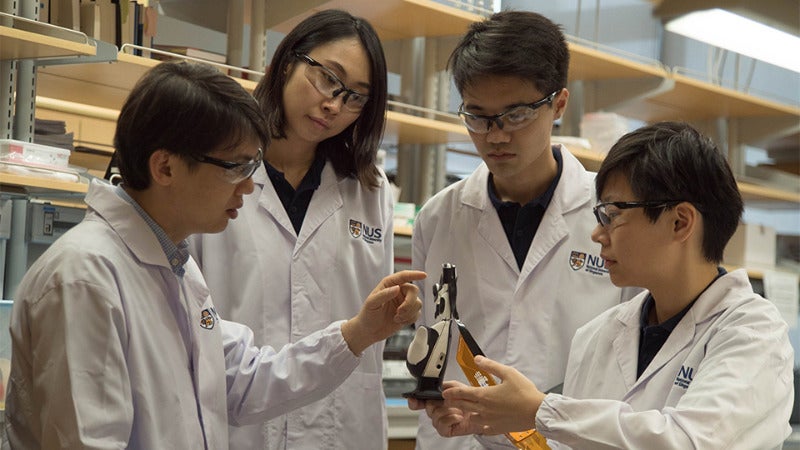
Researchers at the National University of Singapore (NUS) have developed an artificial nervous system that could offer an enhanced sense of touch for prosthetic devices and robots.
The Asynchronous Coded Electronic Skin (ACES), which is said to feature ultra-high responsiveness, can be used with any type of sensor skin layers.

Discover B2B Marketing That Performs
Combine business intelligence and editorial excellence to reach engaged professionals across 36 leading media platforms.
ACES is similar to the human sensor nervous system in detecting signals but contains a network of sensors instead of nerve bundles in the human skin.
According to the research team, ACES can identify touch more than 1,000 times faster than the human sensory nervous system.
It can distinguish physical contact between different sensors in less than 60 nanoseconds, which is said to be the fastest for any electronic skin technology.
ACES-enabled skin can also accurately determine the shape, texture and hardness of objects within ten milliseconds. The researchers attribute this to the system’s precision and capture speed.
The electronic skin system’s sensors are connected to a single electrical conductor and operate independently, making it less sensitive to damage compared to current electronic skins with interlinked wiring systems.
ACES-enabled skin will also be able to function with just one connection between the sensor and the conductor.
NUS Materials Science and Engineering assistant professor Benjamin Tee said: “The human sensory nervous system is extremely efficient, and it works all the time to the extent that we often take it for granted. It is also very robust to damage.
“Our sense of touch, for example, does not get affected when we suffer a cut. If we can mimic how our biological system works and make it even better, we can bring about tremendous advancements in the field of robotics where electronic skins are predominantly applied.”
The team added that the electronic skin system can be scaled-up for artificial intelligence (AI) applications in prosthetic devices, robots and other human machine interfaces.
The flexibility of pairing ACES with any sensor skin layers is expected to enable a variety of applications, including self-repairing electronic skin for prosthetic limbs that could restore sense of touch in disabled individuals.


