
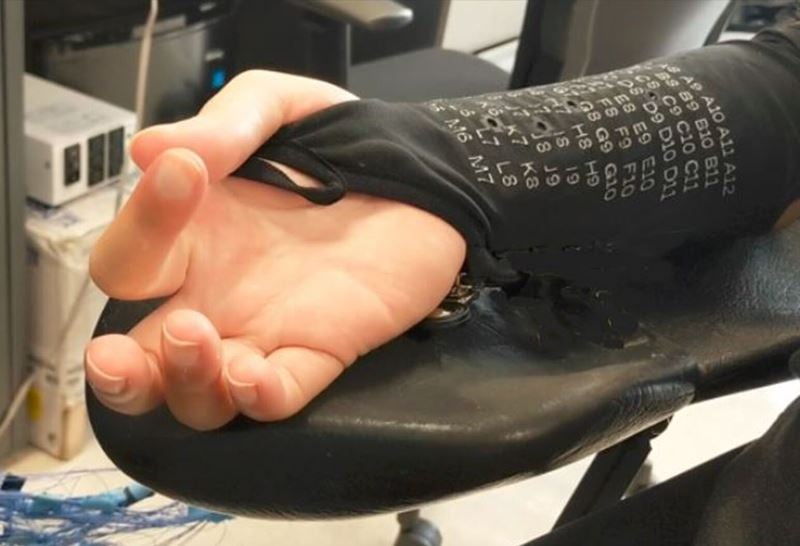
Textile-based electrodes have been used to trigger individual finger movements and grasping reflexes in quadriplegic patients.
Researchers at the Feinstein Institutes for Medical Research and smart textile company Myant have partnered to develop a lightweight wearable sleeve that regulates individual finger forces to facilitate functional movement in paralysed people. The results of their study have now been published in Bioelectronic Medicine.
Go deeper with GlobalData


Discover B2B Marketing That Performs
Combine business intelligence and editorial excellence to reach engaged professionals across 36 leading media platforms.
Feinstein Institute of Bioelectric Medicine vice president of advanced engineering Chad Bouton said: “We developed an approach that accurately controls muscle contractions and resulting forces exerted by the fingers. This opens up future research possibilities to create portable, rehabilitative devices beyond the laboratory to help those living with paralysis.”
Over-the-skin neuromuscular stimulation is often used in physical rehabilitation for people with paralysis, however there are limitations for these non-invasive stimulation systems. Not being able to target all muscles, muscle fatigue and inconsistent contraction strength can all put limits on the technology.
A study of the fabric, consisting of three able-bodied participants and two quadriplegics, found that controlled electrical stimulation along with the use of light-weight textile electrodes meant grasp force could be initiated and regulated in those with quadriplegia.
The participants had the sleeve placed on their forearm and electrical stimulation was applied to the different electrodes to trigger movements. All participants exhibited finger extension and flexing, as well as a cylindrical grasp which enabled them to squeeze and support a 750ml water bottle.
The researchers hope that in the future this technology could be implemented alongside an in-brain computer to decode and control hand movements for paralysed people.
Feinstein Institutes CEO and president Kevin Tracey said: “Chad Bouton and his team continue to advance our understanding and application of the science to better help those living with paralysis.”
Approximately 5.4 million people are living with paralysis in the US, with stroke and spinal cord injury the two leading causes.


