
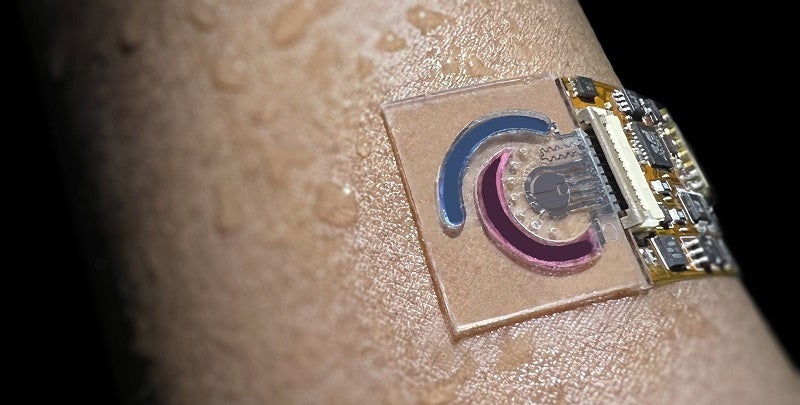
A team of researchers from the California Institute of Technology’s (Caltech) Cherng Department of Medical Engineering has announced a new wearable sensor that can identify many common nutrients and biological compounds in human sweat.
Caltech medical engineering assistant professor Wei Gao has developed the new sweat sensor technology.
Go deeper with GlobalData


Discover B2B Marketing That Performs
Combine business intelligence and editorial excellence to reach engaged professionals across 36 leading media platforms.
The previous versions of Wei Gao’s sweat sensors were dependent on embedded enzymes for the identification of a limited number of relevant compounds. Meanwhile, if antibodies were used in the sensors, they could only be used once.
The new technology includes molecularly imprinted polymers, which are like reusable, artificial antibodies.
Wei Gao’s invention involves the combination of a specially formed polymer with a material that can be oxidised or reduced under an applied electrical voltage when it comes in contact with human sweat.
Sweat comes into contact with the sensor’s inner layer and generates an electrical signal as long as the glutamine-shaped holes in the polymer are open.
As they come into contact with the polymer, the glutamine molecules fill the holes and prevent sweat from reaching the inner layer. This weakens the electrical signal.
Researchers can monitor the electrical signal to deduce how much glutamine is present in the sweat. A weaker signal means there is more glutamine, while a stronger signal shows that there is less.
Nine essential amino acids and multiple vitamins can all be identified using this same unique strategy.
The polymer can also be reused, as the target molecule can be cleared using a weak electrical signal.
The second innovation in the new wearable technology involves the use of microfluidics technology, which allows the sensor to operate when only very small amounts of sweat are present.
Wei Gao said: “This approach allows us to detect a bunch of new crucial nutrients and metabolites. We can monitor when we eat and watch nutrient levels change.
“It not only monitors nutrients, but also hormones and drugs. It can provide continuous monitoring for many health conditions.”
Until now, the new sensor technology has only been shown to work on human subjects in laboratory settings.
Wei Gao plans to test the wearable sensor technology in large-scale human trials in the future.
Funding for the research was provided by The Office of Naval Research, the High Impact Pilot Research Award, a Caltech-City of Hope Biomedical Initiative pilot grant, the National Institutes of Health, the Translational Research Institute for Space Health through NASA and the Tobacco-Related Disease Research Program.


