
The medical devices industry continues to be a hotbed of innovation, with activity driven by increased need for homecare, preventative treatments, early diagnosis, reducing patient recovery times and improving outcomes, as well as growing importance of technologies such as machine learning, augmented reality, 5G and digitalization. In the last three years alone, there have been over 450,000 patents filed and granted in the medical devices industry, according to GlobalData’s report on Innovation in Medical Devices: ML-guided microscopy. Buy the report here.
Go deeper with GlobalData


Discover B2B Marketing That Performs
Combine business intelligence and editorial excellence to reach engaged professionals across 36 leading media platforms.
However, not all innovations are equal and nor do they follow a constant upward trend. Instead, their evolution takes the form of an S-shaped curve that reflects their typical lifecycle from early emergence to accelerating adoption, before finally stabilising and reaching maturity.
Identifying where a particular innovation is on this journey, especially those that are in the emerging and accelerating stages, is essential for understanding their current level of adoption and the likely future trajectory and impact they will have.
150+ innovations will shape the medical devices industry
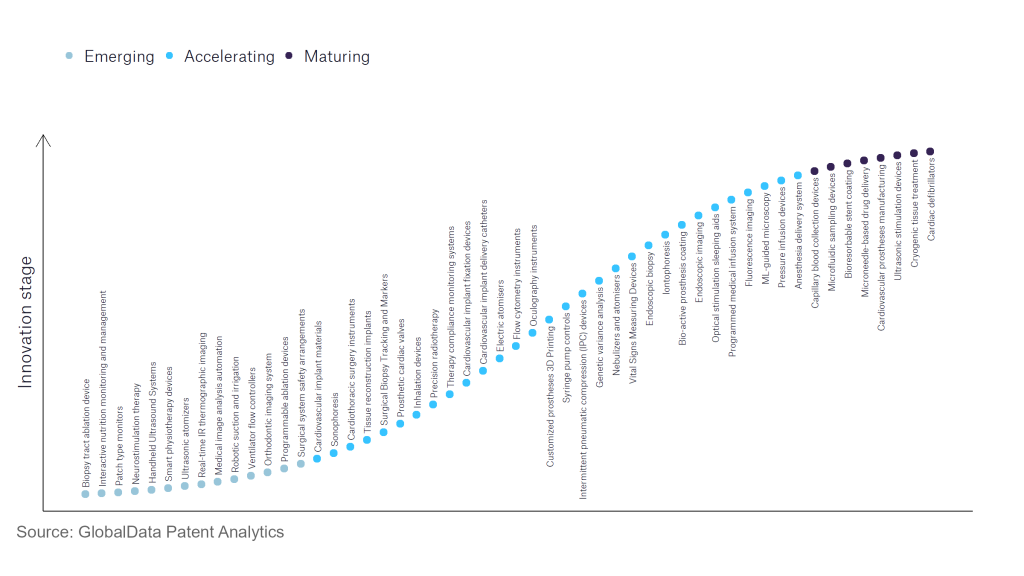
According to GlobalData’s Technology Foresights, which plots the S-curve for the medical devices industry using innovation intensity models built on over 550,000 patents, there are 150+ innovation areas that will shape the future of the industry.
Within the emerging innovation stage, neurostimulation therapy, smart physiotherapy devices, and real-time IR thermographic imaging are disruptive technologies that are in the early stages of application and should be tracked closely. Precision radiotherapy, electric atomisers, and bio-active prosthesis coating are some of the accelerating innovation areas, where adoption has been steadily increasing. Among maturing innovation areas are bioresorbable stent coating and cryogenic tissue treatment, which are now well established in the industry.
Innovation S-curve for the medical devices industry
ML-guided microscopy is a key innovation area in the medical devices industry
Machine learning (ML) - guided microscopy uses machine learning algorithms to automate and enhance the microscopic imaging process. Clinical data is utilized for training the algorithms to process a large amount of microscopy data and construct accurate images without losing resolution. Unlike the traditional approach, which could take many days to process data, automated microscopy techniques allow accurate and enhanced imaging in seconds in real time.
GlobalData’s analysis also uncovers the companies at the forefront of each innovation area and assesses the potential reach and impact of their patenting activity across different applications and geographies. According to GlobalData, there are 60+ companies, spanning technology vendors, established medical devices companies, and up-and-coming start-ups engaged in the development and application of ML-guided microscopy.
Key players in ML-guided microscopy – a disruptive innovation in the medical devices industry
‘Application diversity’ measures the number of different applications identified for each relevant patent and broadly splits companies into either ‘niche’ or ‘diversified’ innovators.
‘Geographic reach’ refers to the number of different countries each relevant patent is registered in and reflects the breadth of geographic application intended, ranging from ‘global’ to ‘local’.
Heartflow and F. Hoffmann-La Roche are two of the leading patent filers in ML-guided microscopy. Some other leading patent filers include Microsoft, Amgen and Sony Group.
In terms of application diversity, Medtronic leads the pack, followed by Magic Leap and Becton Dickinson, respectively. By means of geographic reach, Becton Dickinson holds the top position, followed by Amgen and Magic Leap in the second and third spots, respectively.
ML-guided microscopy uses machine learning methods to program complex microscopy imaging processes using clinical data. The development of large training datasets and sophisticated ML algorithms capable of constructing accurate pictures while preserving image resolution will improve the accuracy of diagnosis procedures, enabling real-time imaging and monitoring of complex life processes, such as brain activity.
To further understand the key themes and technologies disrupting the medical devices industry, access GlobalData’s latest thematic research report on Medical Devices.
Data Insights
From

The gold standard of business intelligence.
Blending expert knowledge with cutting-edge technology, GlobalData’s unrivalled proprietary data will enable you to decode what’s happening in your market. You can make better informed decisions and gain a future-proof advantage over your competitors.

GlobalData, the leading provider of industry intelligence, provided the underlying data, research, and analysis used to produce this article.
GlobalData’s Patent Analytics tracks patent filings and grants from official offices around the world. Textual analysis and official patent classifications are used to group patents into key thematic areas and link them to specific companies across the world’s largest industries.


