
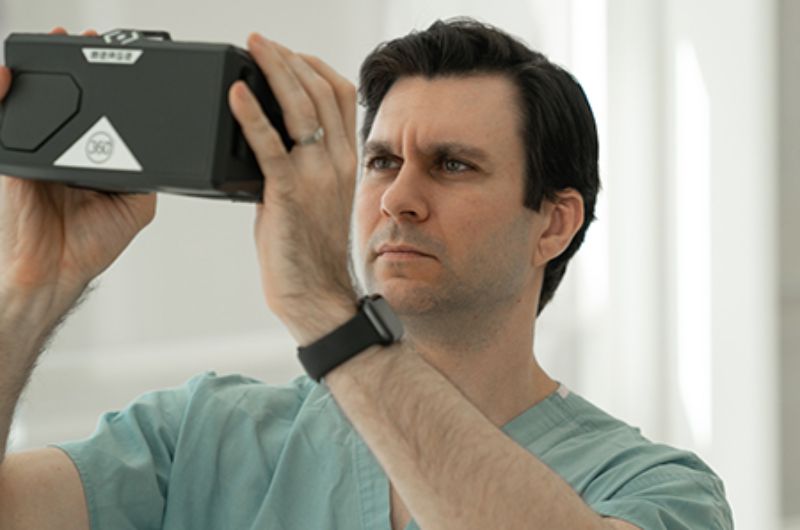
A new study led by UCLA Health in the US has shown that three-dimensional (3D) virtual reality models could improve surgical outcomes by enabling better visualisation of a patient’s anatomy.
When tested in preparation for kidney tumour surgeries, the models led to shorter operating times, less blood loss during surgery, and a shorter hospital stay following the procedure.
Go deeper with GlobalData


Discover B2B Marketing That Performs
Combine business intelligence and editorial excellence to reach engaged professionals across 36 leading media platforms.
According to the researchers, previous studies focused on the qualitative performance of 3D models. The latest study was conducted for quantitative evaluation of the technology’s ability to improve patient outcomes.
The virtual reality models improve the visualisation of a person’s anatomy, allowing surgeons to see the structure’s depth and contour.
UCLA David Geffen School of Medicine clinical instructor Dr Joseph Shirk said: “Surgeons have long since theorised that using 3D models would result in a better understanding of the patient anatomy, which would improve patient outcomes.
“But actually seeing evidence of this magnitude, generated by very experienced surgeons from leading medical centres, is an entirely different matter. This tells us that using 3D digital models for cancer surgeries is no longer something we should be considering for the future – it’s something we should be doing now.”
In the latest study, 48 patients were randomised into the control group and 44 into the intervention arm.
For surgery of participants in the control arm, the surgeon prepared for the procedure by reviewing CT or MRI scans.
For patients in the intervention arm, the surgeon reviewed the CT or MRI scan, as well as the 3D virtual reality model. The 3D models were reviewed via the surgeon’s mobile phones and a virtual reality headset.
The technology leveraged by the study was provided by the company Ceevra.
Shirk noted: “Visualising the patient’s anatomy in a multicolour 3D format, and particularly in virtual reality, gives the surgeon a much better understanding of key structures and their relationships to each other.”
The researchers expect that the 3D models can be used for planning surgeries of various type of cancers, including prostate, lung, liver and pancreas.



