
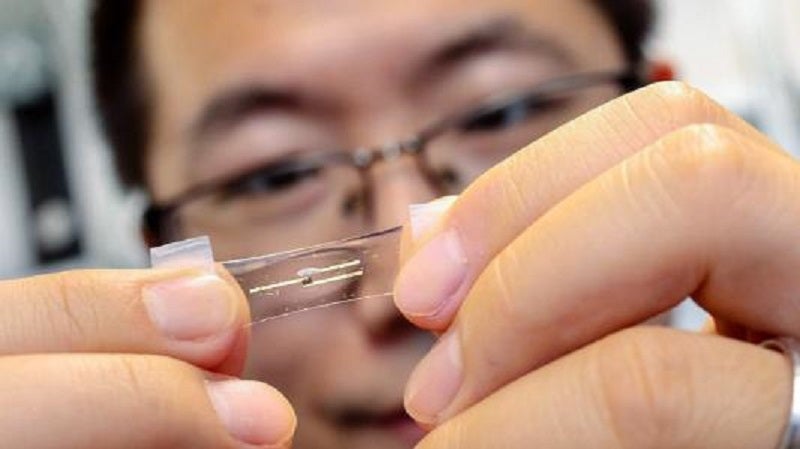
The US Department of Energy’s (DOE) Argonne National Laboratory and the University of Chicago-based Pritzker School of Molecular Engineering (PME) are developing a new skin-like device for monitoring health.
Combined with artificial intelligence (AI), the new flexible, wearable device would be attached to the skin and use precision medical sensors for diagnosis and health monitoring.
Go deeper with GlobalData


Discover B2B Marketing That Performs
Combine business intelligence and editorial excellence to reach engaged professionals across 36 leading media platforms.
Argonne National Laboratory stated that the device can detect potential health issues, such as cancer, heart disease or multiple sclerosis, even before symptoms appear.
It can personalise analysis of the tracked health data and also reduce the necessity for wireless transmission.
PME assistant professor Sihong Wang said: “The diagnosis for the same health measurements could differ depending on the person’s age, medical history and other factors.
“Such a diagnosis, with health information being continuously gathered over an extended period, is very data intensive.
US Tariffs are shifting - will you react or anticipate?
Don’t let policy changes catch you off guard. Stay proactive with real-time data and expert analysis.
By GlobalData“While still requiring further development on several fronts, our device could be a game changer in which everyone can get their health status in a much more effective and frequent way.”
The companies used neuromorphic computing, which mimics brain operations.
This AI technology has benefits, including compatibility with stretchable material, less energy consumption and faster speed compared to other AI types.
The new skin-like neuromorphic ’chip’ comprises a thin plastic semiconductor layer combined with stretchable gold nanowire electrodes.
Argonne National Laboratory said that the device performed as intended even when it was stretched to double its regular size.
The project team developed an AI device and trained it to identify four different electrocardiogram (ECG) signals that indicate different types of health issues.
The device was found to be more than 95% accurate in recognising the ECG signals after training.
Argonne National Laboratory physicist Joe Strzalka said: “We look forward to studying the device material under its regular operating conditions, interacting with charged particles and changing electrical potential in its environment.”
The National Science Foundation, the US Office of Naval Research and a start-up fund from the University of Chicago provided funding for the project.



