
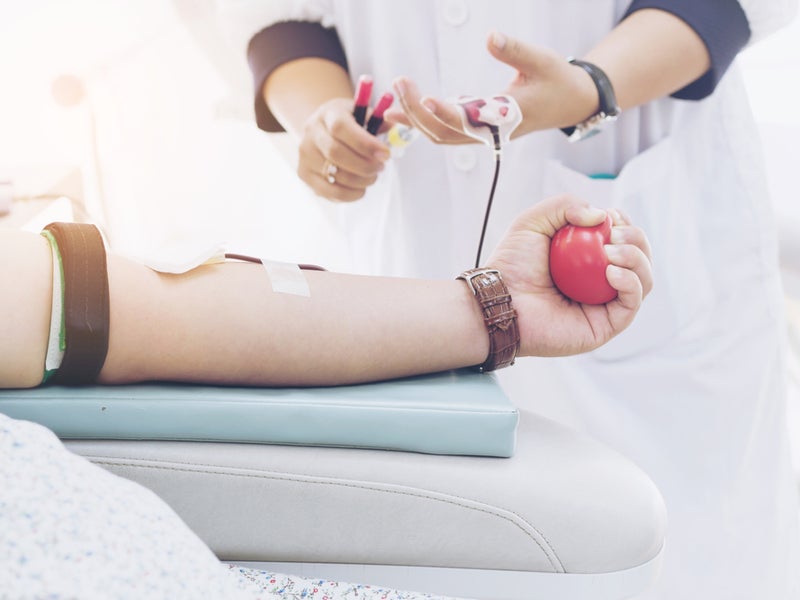
High-quality blood donors could soon be singled out using a microfluidic device developed at the University of British Columbia (UBC).
Certain people’s red blood cells stay viable for longer after extraction, both in storage and in a recipient’s body. This is related to the ability of the cells to squeeze through small constrictions, which is known as their deformability.
Go deeper with GlobalData


Discover B2B Marketing That Performs
Combine business intelligence and editorial excellence to reach engaged professionals across 36 leading media platforms.
The physical and chemical conditions of cold storage can cause red blood cells to lose their deformability. Cells that remain deformable for longer under these conditions can stay in circulation for longer, but clinicians lack a reliable way to measure this capacity in donated red blood cells.
The UBC research team filtered red blood cells from eight different donors through a custom-made microfluidics device to see how their deformability was maintained during storage.
Samples from two of the donors remained significantly more stable than the other six.
UBC professor of mechanical engineering Hongshen Ma said: “We found that samples from two of the donors were significantly more stable – they remained deformable during the storage period – than other donors.
“We need to study this phenomenon further, but this result suggests that it will be possible to identify donors that can provide long circulating red blood cells for sensitive recipients.”
The team plans to work with the Canadian Blood Services to test more donor samples. This will allow them to further develop their device and validate their initial results.
UBC clinical professor in pathology and laboratory medicine Mark Scott said: “People who need frequent blood transfusions benefit tremendously from red blood cells that that are able to appropriately circulate in the blood vessels to deliver oxygen.
“A method that can swiftly and accurately test the ‘squeezability’ of these cells can make transfusions safer for these patients and ultimately for anyone who needs a critical transfusion.”



