
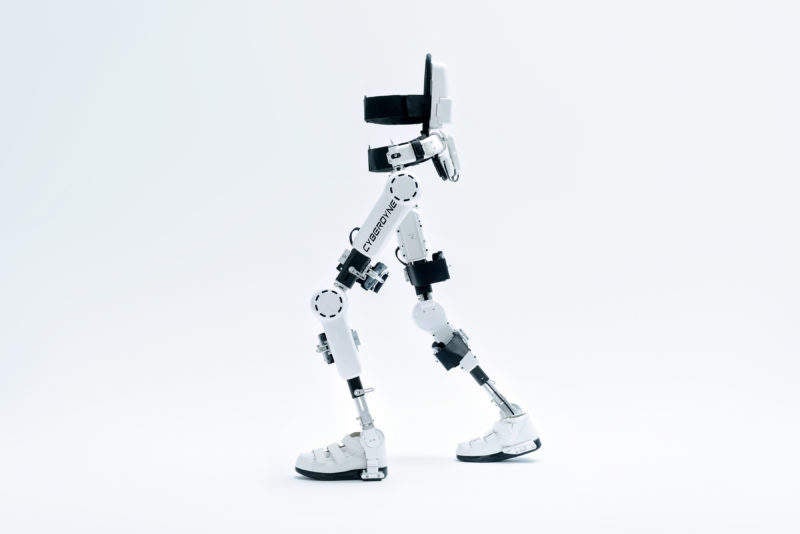
Cyberdyne has announced that its exoskeleton will be available in the US, thanks to a partnership with the newly-opened Brooks Cybernic Treatment Center of Jacksonville, Florida.
The Hybrid Assistive Limb (HAL) is designed to rehabilitate patients who have lower limb disorders, such as a spinal injuries or diseases of the brain and neuromuscular system.
Go deeper with GlobalData


Discover B2B Marketing That Performs
Combine business intelligence and editorial excellence to reach engaged professionals across 36 leading media platforms.
The FDA-approved device fits around the user’s abdomen and legs, providing support and the framework to rebuild neural pathways to the legs.
Patients control movement using their mind using a non-intrusive EEG-like sensor to pick up nerve signals from the brain, which are then translated into a command to engage small motors in the suit’s legs.
It requires some degree of sensation for the treatment to work, but over time use of the device trains the user to activate specific neural pathways for voluntary movement. The physical feedback to the brain can eventually help patients to walk on their own.
“We’ve already seen the results of improved mobility and ability to walk in patients with spinal cord injury (SCI) at several international locations that are providing this technology,” said medical director of the Brooks Cybernic Treatment Center Dr Geneva Tonuzi.

US Tariffs are shifting - will you react or anticipate?
Don’t let policy changes catch you off guard. Stay proactive with real-time data and expert analysis.
By GlobalData“We are very excited about this new partnership with Cyberdyne Inc. and their incredible technology.”
“Through our partnership, we will be able to introduce the medical HAL device to the United States, as well as serve as a training and research facility to better understand how we can help those who are affected by both incomplete tetraplegia and paraplegia.”
Brooks Cybernic Treatment Center currently has eight medical robots of varying sizes, which they lease from Cyberdyne. It will be used alongside previous pieces of technologies, including other exoskeletons and bodyweight support systems.
President and CEO of Cyberdyne Dr Yoshiyuki Sankai, said: “Wearing HAL leads to a fusion of human, robot, and information systems.”
“I’m pleased that Cybernic Technology will now benefit patients in the US, helping to improve their walking ability as well as gain other functional and physiological benefits.”
Cyberdyne first launched the HAL in 2011, and has since used it in a number of Japanese hospitals.
Recently, scientists produced a machine learning algorithm that can measure the movements of individual human bodies to help develop personalised, wearable exosuits.



