
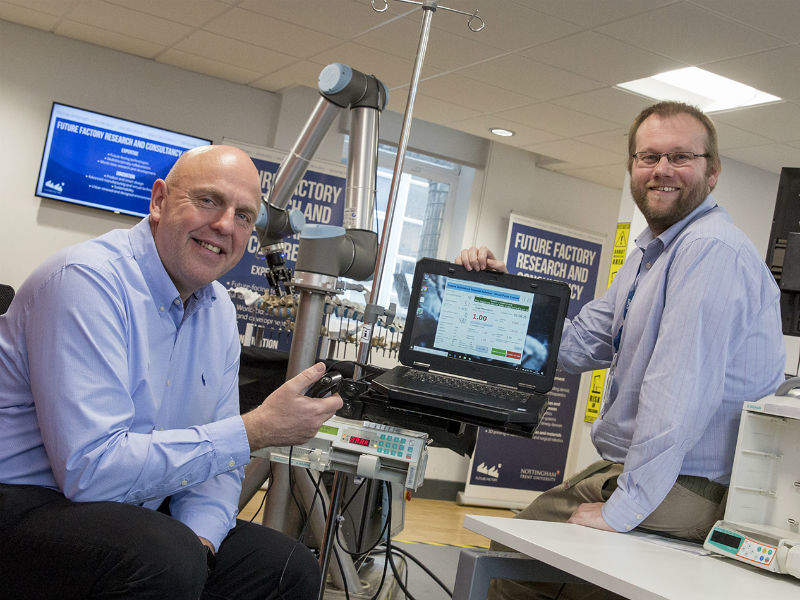
Patients undergoing operations while awake will be able to administer their own doses of intravenous sedation at the touch of a button.
A new device, developed by Nottingham University Hospitals NHS Trust in collaboration with product design researchers at Nottingham Trent University (NTU), enables patients to be in control of how awake they want to be during surgery.
Go deeper with GlobalData


Discover B2B Marketing That Performs
Combine business intelligence and editorial excellence to reach engaged professionals across 36 leading media platforms.
The concept behind the technology is that only patients knows how nervous they feel on the operating table so they should be able to take control of their own anxiety levels. It could allow for swifter recovery times by reducing exposure to the drug’s side effects if a patient chooses to have a lower dose than would be normally administered.
The technology comes with a safety feature which sets minimum and maximum sedative levels to prevent patients from under- or overdosing themselves. An anaesthetist would also remain in the operating theatre observing the patient at all times while the device is in use.
NTU was awarded more than £376,000 by National Institute for Health Research (NIHR) to develop the hardware and software for the project.
Professor Philip Breedon, who leads Nottingham Trent’s Medical Design Research Group, said: “Undergoing surgery can be a worrying experience so patients are sedated. Propofol is very effective but, like many drugs, it has side effects that can prolong recovery.
US Tariffs are shifting - will you react or anticipate?
Don’t let policy changes catch you off guard. Stay proactive with real-time data and expert analysis.
By GlobalData“By putting the control of drug delivery directly into a patient’s hand, less propofol can be used without compromising the patient’s comfort, which we expect will lead to swifter recovery times.”
Nottingham Trent research fellow Dr James Sprinks, who is developing the technology, added: “Because there’s no real way of knowing how anxious a person feels, anaesthetists often err on the side of caution and have to administer larger doses to ensure that operations run smoothly.
“But this technology will help ensure that patients receive more suitable doses. It will also make patients feel more in control and anaesthetists will be provided with live data on how much the patient is taking.”
An initial study of the technique involving 25 patients at Nottingham University Hospitals NHS Trust showed that when patients were able to choose how awake to be for surgery they needed less propofol than an anaesthetist would have administered.
Different patients also took the drug at different points of their operation. Patients who felt anxious before the operation tended to use more at the start. Those who felt relaxed at the beginning tended to ask for more propofol later on.
Principal investigator Dr Nigel Bedforth, consultant anaesthetist at Nottingham University Hospitals NHS Trust, said: “This is a pioneering project which could have a huge impact on the way operations involving conscious patients are undertaken around the world.
“It shows that by working in collaboration can we develop new technologies and introduce new anaesthetic techniques which help improve the experience of patients undergoing surgery.”
So far the researchers have predominately focused on adapting the technology for orthopaedic operations, such as for knee and hip replacements.
Nottingham University Hospitals NHS Trust anaesthetic registrar Dr David Hewson said: “In the future, this technology could be widened out to other forms of medical or surgical procedure which require patients to be awake.
“It could make a huge difference to the experience patients receive while also creating efficiencies for the NHS.”



