
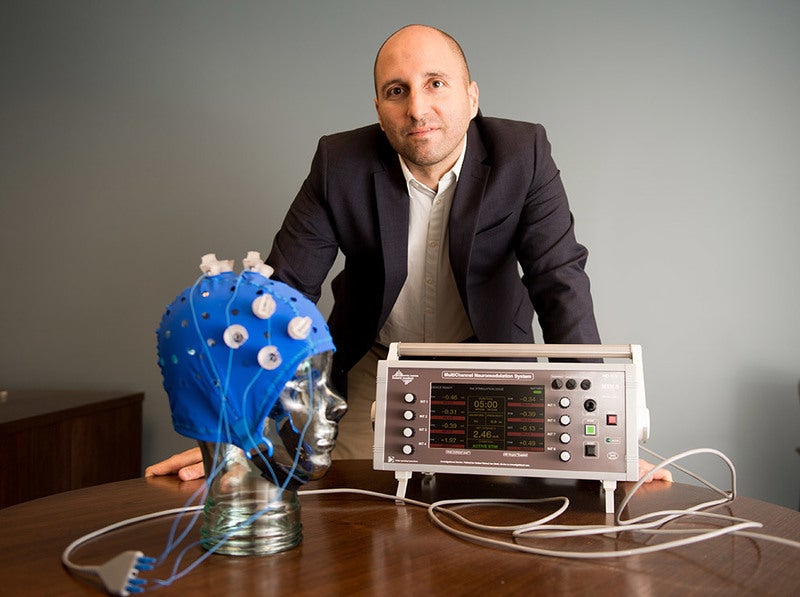
Researchers at Boston University have discovered that an electrostimulation of the brain (ESB) technique could be used to improve working memory.
This cognitive system is used to store temporary information and make unconscious decisions. The brain uses low-frequency waves known as beta rhythms to switch between different pieces of information. Working memory declines with age, which results in cognitive difficulties.
Go deeper with GlobalData


Discover B2B Marketing That Performs
Combine business intelligence and editorial excellence to reach engaged professionals across 36 leading media platforms.
Published in the Nature Neuroscience journal, a study conducted by the university showed that non-invasive stimulation of the brain in areas where beta rhythms had declined increased the performance of working memory.
Two groups of participants, one aged between 20 and 30 years and the other in their 60s and 70s, performed a set of memory tasks. At baseline, the younger group was observed to be more accurate at these tasks compared with the older group.
After 25 minutes of mild stimulation using scalp electrodes, the performance of older adults was claimed to be indistinguishable from that of the 20-year-olds. The treatment was customised to each person’s brain circuits.
The memory boost was found to last for at least 50 minutes following stimulation.
The researchers noted that loss of coordination in the coupling and synchronisation mechanisms of working memory is thought to be responsible for its decline. The study demonstrated that electrical stimulation restores these pathways and improves memory by restoring the flow of information within the brain.
While further research is needed to validate these findings, the researchers believe that the approach offers hope to improve brain function in people with age-related cognitive decline such as dementia and Alzheimer’s patients.
During the study, 14 participants in the younger age group did not perform well on the memory tasks conducted pre-treatment. However, electrostimulation also boosted their working memory.
Boston University College of Arts & Sciences psychological and brain sciences assistant professor Rob Reinhart said: “We showed that the poor performers who were much younger, in their 20s, could also benefit from the same exact kind of stimulation. We could boost their working memory even though they weren’t in their 60s or 70s.”
The researcher is planning to further study the effects of electrostimulation on individual brain cells in animal models, as well as the impact of repeated doses on human brain circuits.



