
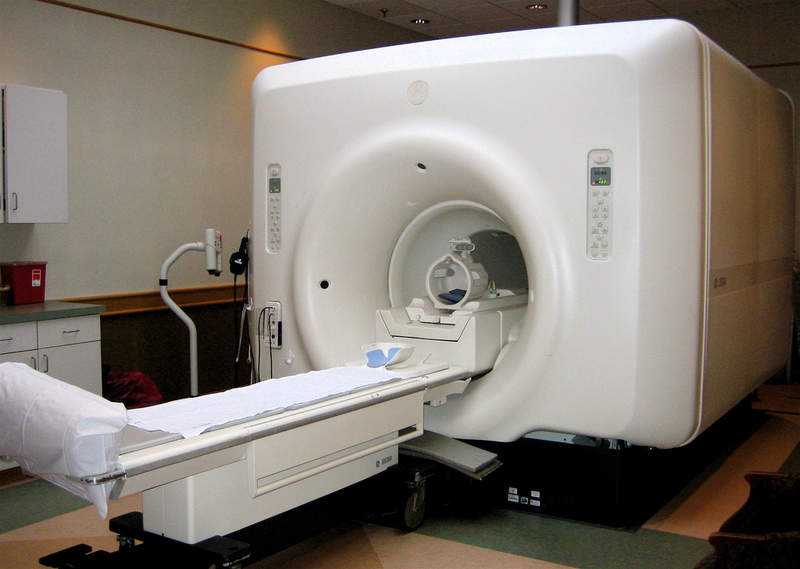
Facebook has partnered with New York University (NYU) School of Medicine to initiate a research project focussed on leveraging artificial intelligence (AI) to make magnetic resonance imaging (MRI) scans ten times faster.
Under the ‘fastMRI’ collaboration, Facebook AI Research (FAIR) group and the medical school’s Radiology department will investigate the use of AI in expediting the reconstruction of MR images.
Go deeper with GlobalData


Discover B2B Marketing That Performs
Combine business intelligence and editorial excellence to reach engaged professionals across 36 leading media platforms.
Commonly, patients are required to lie inside a MRI’s chamber for 15-50 minutes. The partners intend to significantly cut down this time by using AI to capture less data during the scan.
A statement from Facebook read: “Using AI, it may be possible to capture less data and therefore scan faster, while preserving or even enhancing the rich information content of magnetic resonance images.
“The key is to train artificial neural networks to recognise the underlying structure of the images in order to fill in views omitted from the accelerated scan.”
As part of the collaboration, the university will provide Facebook with access to about three million images of MRI scans of the knee, brain and liver. This data from 10,000 clinical cases will be used to train the algorithms.
US Tariffs are shifting - will you react or anticipate?
Don’t let policy changes catch you off guard. Stay proactive with real-time data and expert analysis.
By GlobalDataAccording to Facebook and NYU, patient names and all other critical health information have been removed from the images, as well as raw scanner data.
The partners intend to open-source their work to enable other researchers to replicate and build on their findings.
NYU imaging specialist Dan Sodickson was quoted by Forbes as saying: “The benefits of this are really dramatic in the real world.
“If we can get it fast enough to replace X-rays or CT then we can also reduce radiation exposure for the population while still getting the critical medical information.”



