
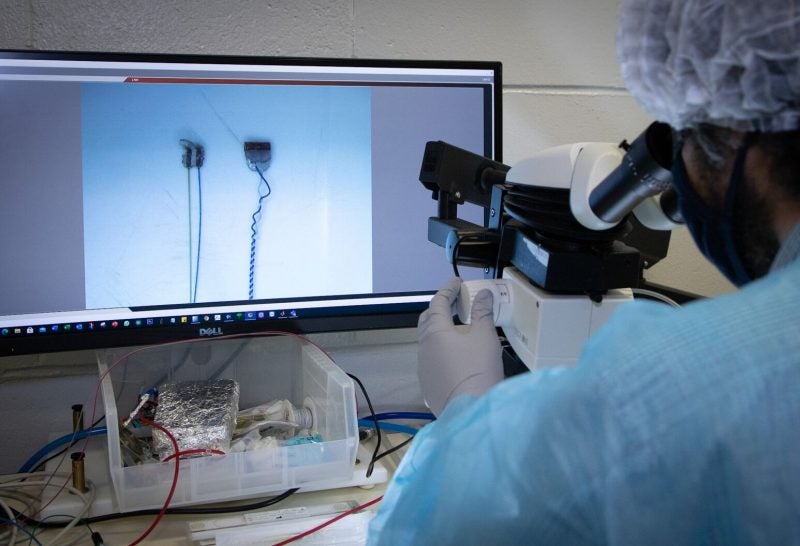
Scientists at the Institute of Bioelectronic Medicine at The Feinstein Institutes for Medical Research have developed a long-term nerve implant model for bioelectronic medicine research.
Developed for vagus nerve stimulation (VNS) in mice, the implant can moderate heart rate as well as inflammatory proteins.
Go deeper with GlobalData


Discover B2B Marketing That Performs
Combine business intelligence and editorial excellence to reach engaged professionals across 36 leading media platforms.
The device and procedure could potentially alter the way preclinical bioelectronic medicine research is carried out and usher in alternative therapies for chronic diseases such as Crohn’s, rheumatoid arthritis and heart failure.
The Feinstein Institutes assistant professor Stavros Zanos said: “To better understand the power VNS may hold in treating some of the most devastating conditions and diseases, we needed a device to deliver long-term stimulation in preclinical studies.
“This new research will hopefully act as a blueprint for institutions worldwide to help advance the exciting field of bioelectronic medicine.”
The brain and organs communicate and control homeostases, like heart rate and oxygen levels, via the vagus nerve.

US Tariffs are shifting - will you react or anticipate?
Don’t let policy changes catch you off guard. Stay proactive with real-time data and expert analysis.
By GlobalDataVNS is the study of how nerve mapping and modulation can affect functions of the body, especially inflammation, which is the cause of many autoimmune disorders.
There exist surgical and technological challenges in implanting a stimulator that will fit the tiny vagus nerve of a mouse. This cuff-electrode and surgical procedure allow more long-term and detailed VNS research to be carried out.
The device can be implanted for at least four weeks, whereas previous VNS studies were limited to short-term stimulation.
The researchers assessed how the VNS affected physiological functions, including regulation of heart rate and breathing, for four weeks and noticed responses in 60-90% of the mice.
The device did not hamper any other bodily functions, such as appetite and blood pressure.
Furthermore, the team found that stimulation through long-term implants could significantly suppress tumour necrosis factor (TNF), a protein that causes inflammation.



