
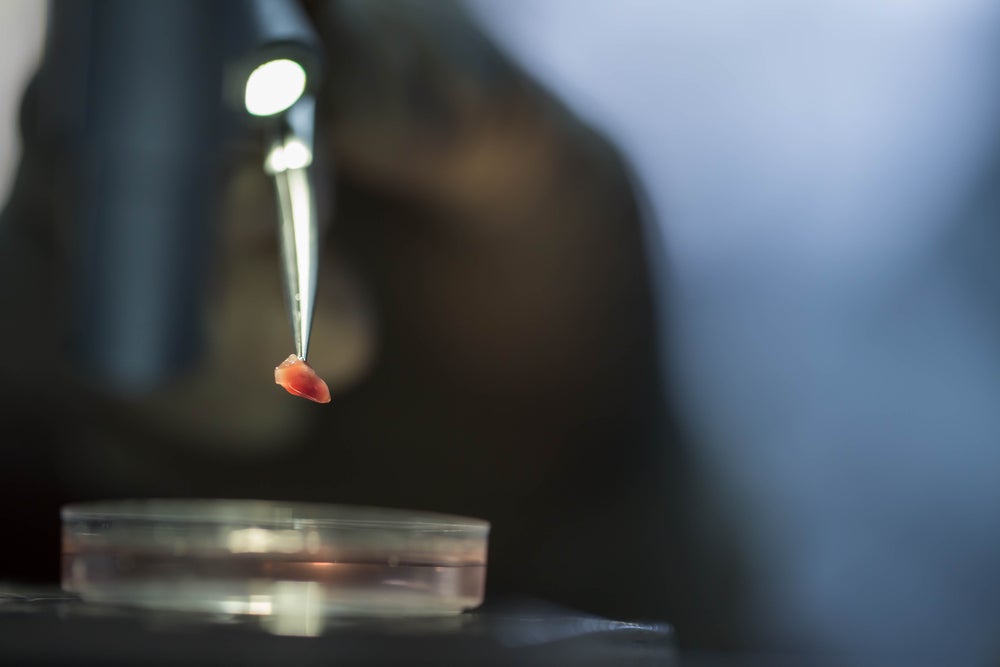
US-based biotechnology company FluidForm Bio has made an advancement in 3D-printing human cardiac tissue using freeform reversible embedding of suspended hydrogels (FRESH) 3D bioprinting, as detailed in a research paper published in APL Bioengineering.
The research paper, titled ‘FRESH 3D-bioprinted cardiac tissue’, a bioengineered platform for in vitro pharmacology, highlights how FluidForm has used human induced pluripotent stem cell-derived cardiomyocytes (hiPSC-CMs) to create an accurate model for human cardiac physiology in drug development. The study was conducted in collaboration with scientists at FluidForm and Merck (MSD).
Go deeper with GlobalData


Discover B2B Marketing That Performs
Combine business intelligence and editorial excellence to reach engaged professionals across 36 leading media platforms.
FRESH uses an embedded printing approach with a temporary support gel that makes it possible to 3D print complex scaffolds using collagen in its native unmodified form.
In the announcement accompanying the breakthrough, FluidForm CTO and co-founder Adam Feinberg said: “We are not aware of any other biofabrication or tissue engineering approaches that can achieve comparable cell densities and uniaxial alignment on the market today, both of which contribute to a more advanced physiologic function.”
FluidForm Bio was founded in 2018, with co-founder Adam Feinberg developing the FRESH printing system in 2015 at Carnegie Mellon University. In 2021, FluidForm entered into a partnership with J&J’s medical device subsidiary Ethicon to develop 3D bioprinting solutions, utilising FluidForm’s FRESH bioprinting technology.
According to a GlobalData report, the 3D printing medical market is set to grow in the next few years, from $2bn at the end of 2022 to more than $4bn by 2026.
There have been many developments in the field of 3D printing this year, including the collaboration between CollPlant Biotechnologies and Stratasys to develop 3D-printed breast implants, announced in April. The companies will use Stratasys’ P3 technology-based bioprinter and CollPlant’s tobacco plant-based collagen to bio-fabricate human tissues and organs, producing programmes at an industrial scale.
In May, researchers at the University of Birmingham in the UK developed a path for microfluidic, 3D-bioprinted vessels, tissues, and organs. Microfluidic scaffolds can help in overcoming the challenges associated with 3D cultures, including cost and affordability, meaning shorter wait times for organ transplantation.



