
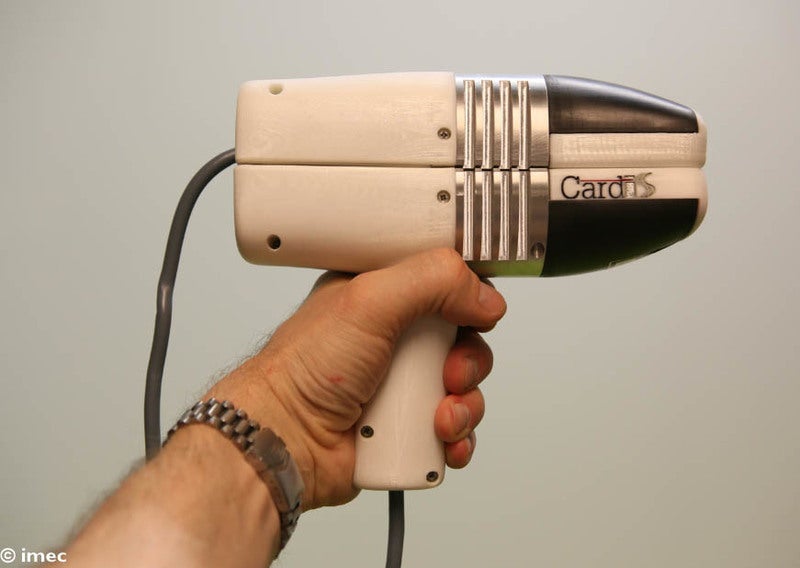
Belgian research hub Imec and Ghent University have partnered with CARDIS project members, including Medtronic, to develop a photonics-based medical device for screening arterial stiffness in order to detect cardiovascular diseases.
Funded by the European Union’s Horizon 2020 programme, CARDIS is focussed on offering a mobile, low-cost, point-of-care device based on silicon photonics for heart diseases diagnosis.

Discover B2B Marketing That Performs
Combine business intelligence and editorial excellence to reach engaged professionals across 36 leading media platforms.
Apart from imec and Medtronic, the project also involves seven more partners.
Under CARDIS, the members created a prototype of the photonic device for quick, reproducible and reliable use with minimal physical contact with the patient.
The device is based on Laser Doppler Vibrometry (LDV), which involves a low-power laser directed towards the skin above an artery.
Doppler shift of the reflected beam is analysed to measure the skin’s vibration amplitude and frequency caused due to the heartbeat.

US Tariffs are shifting - will you react or anticipate?
Don’t let policy changes catch you off guard. Stay proactive with real-time data and expert analysis.
By GlobalDataThe device consists of two rows of six beams, enabling simultaneous scanning of multiple points on the skin overlying the artery.
In addition, the device contains a silicon photonics chip with the optical functionality of a multi-beam LDV device.
Designed by the Photonics Research Group, the CARDIS chip has been incorporated in a handheld device and validated for human use by Medtronic.
Photonics Research Group head Roel Baets said: “Silicon photonics is a powerful technology that combines the unique sensing capabilities of photonics with the low-cost and miniaturisation capabilities of silicon semiconductor technology.
“It’s exciting to know that our silicon photonic chip and prototype medical device hold the promise to change the lives of so many patients with cardiovascular diseases.”
The new photonic device has been assessed in a clinical feasibility study involving 100 patients at the Georges Pompidou European Hospital in Paris, France.
Data showed that the quality of the device readings was good and adequate measurement results were observed in all subjects.
The partners are planning for additional clinical feasibility studies of the device at the Academic Hospital of Maastricht in Netherlands.


