
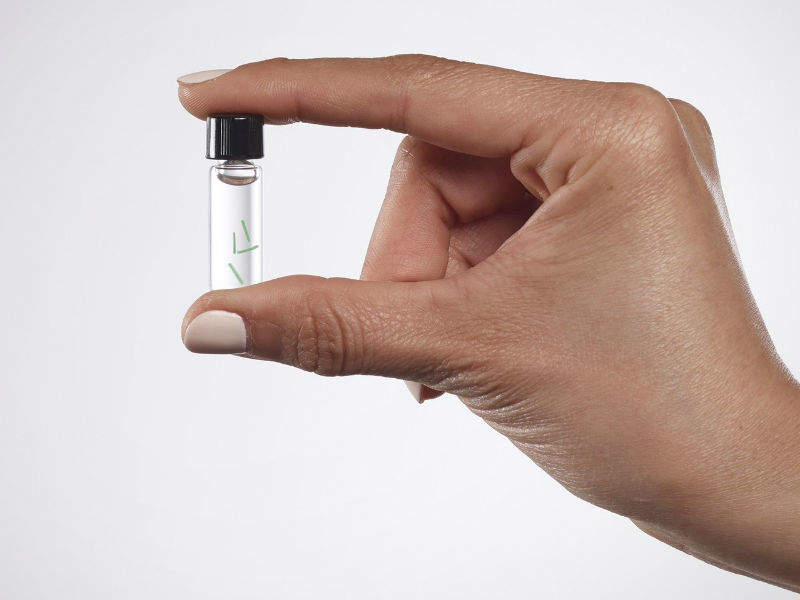
Injectable biosensors that can stream a patient’s personal medical data to smartphones and the cloud are being developed by researchers at bioengineering company Profusa.
Test results show that the tiny sensors have overcome the barriers of local inflammation and scar tissue from the so-called ‘foreign body response’ which has previously prevented the development of in-body sensors for long-term monitoring.

Discover B2B Marketing That Performs
Combine business intelligence and editorial excellence to reach engaged professionals across 36 leading media platforms.
Profusa chief technology officer and co-founder Dr Natalie Wisniewski, who leads the team of biosensor developers, said: “While fitness trackers and other wearables provide insights into our heart rate, respiration and other physical measures, they don’t provide information on the most important aspect of our health: our body’s chemistry.
“Based on our ongoing studies, tissue-integrated sensor technology has the potential to enable wearables to live up to the promise of personalised medicine, revolutionising the management of health in wellness and disease.”
Conventional sensors, such as those found in continuous glucose monitors, have a sensing electrode wire that penetrates the skin to measure a target chemical in the fluid that surrounds cells. This triggers what is known as a foreign body response as the patient’s body views the electrode as a foreign object that needs to be removed. To avoid the effects of the resulting inflammation and formation of scar tissue, the electrode needs to be removed and replaced within several days at a different location in order to keep functioning accurately.
The researchers at Profusa are developing a family of tiny biosensors composed of a tissue-like hydrogel, similar to a soft contact lens, that are painlessly placed under the skin with a single injection. Rather than being isolated from the body, the biosensors work fully integrated within the body’s tissue, without any metal device or electronics, thereby overcoming the body’s attempts to reject it. To date, the injected biosensors have functioned for as long as four years.
Each biosensor is a flexible fibre, about 5mm long and 0.5mm wide, comprised of a porous scaffold that induces capillary and cellular ingrowth from surrounding tissue. The hydrogel is linked to light-emitting fluorescent molecules that continuously signal in proportion to the concentration of a body chemical, such as oxygen, glucose, or other biomolecules of interest.
A separate optical reader stuck to the skin’s surface or held by hand is used to read the fluorescent signal from the embedded biosensor. The reader sends excitation signals through the skin to the biosensor, which then emits fluorescent light in response to the biomolecule present. The data is then relayed to a smartphone for an encrypted personal record and historical tracking. Data can be shared securely via digital networks with healthcare providers.
The first medical application for Profusa’s biosensor technology was the Lumee Oxygen Platform, which was approved for sale last year in Europe. It is currently helping wound-healing specialists track oxygen in the lower extremities of patients undergoing treatment for chronic limb ischemia. The device is aimed at avoiding amputations by providing information to caregivers about declining oxygen levels in a patient’s limb.
In addition to measuring oxygen, Wisniewski and her colleagues are developing biosensors for the continuous monitoring of glucose, lactate, carbon dioxide, and other molecules, with the aim of broadening their biosensor applications.


