
Researchers from the Massachusetts Institute of Technology (MIT) in the US have developed a new sensor to detect SARS-CoV-2 proteins without antibodies.
The new sensor eliminates the need to send the sample to a lab for analysis using antibodies or other reagents and provides results within five minutes.
Go deeper with GlobalData


Discover B2B Marketing That Performs
Combine business intelligence and editorial excellence to reach engaged professionals across 36 leading media platforms.
It was developed using carbon nanotube sensor technology, which was previously developed in an MIT lab.
MIT chemical engineering Carbon P Dubbs professor Michael Strano said: “A rapid test means that you can open up travel much earlier in a future pandemic.
“You can screen people getting off of an airplane and determine whether they should quarantine or not. You could similarly screen people entering their workplace and so forth.
“We do not yet have technology that can develop and deploy such sensors fast enough to prevent economic loss.”

US Tariffs are shifting - will you react or anticipate?
Don’t let policy changes catch you off guard. Stay proactive with real-time data and expert analysis.
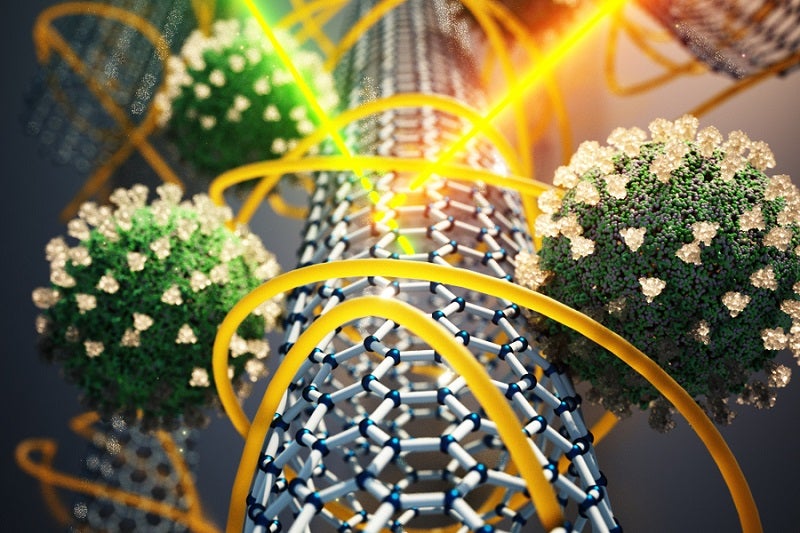
By GlobalDataThe hollow, nanometer-thick cylindrical carbon nanotubes can naturally fluoresce when exposed to laser light.
The MIT researchers have discovered that these tubes create sensors that respond to specific targeted molecules when they are wrapped in various polymers.
Different target virus molecule types will wedge into the gaps between the loops and alter the intensity or peak wavelength of fluorescence produced by the nanotube.
In a separate development, the National Institutes of Health provided funding earlier this year to InnoTech Precision Medicine and Strano to create a CoPhMoRe sensor for SARS-CoV-2 proteins.
The researchers could generate a set of 11 strong viable candidates for SARS-CoV-2 and identified accurate sensors to detect the nucleocapsid and spike protein of the virus within ten days of the start of the project.
They have also incorporated the sensors into a prototype device, which features a fibre optic tip that detects the changes in fluorescence of the biofluid sample in real time.
It was also found that the device could detect the SARS-CoV-2 nucleocapsid protein when it was dissolved in saliva.
The technology used for the sensors can be used to accelerate the process of diagnostics development for Covid-19 as well as for future pandemics.



