
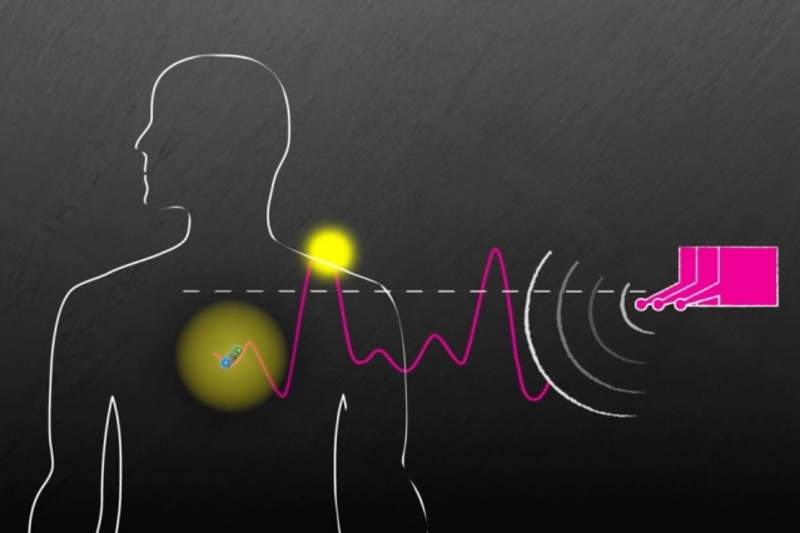
Researchers from the Massachusetts Institute of Technology (MIT) have collaborated with local Brigham and Women’s Hospital to create a new system that can wirelessly power and communicate with medical devices inside the body.
The new In Vivo Networking (IVN) system employs radio frequency waves to power implanted devices. This is expected to eliminate the need for a battery, in turn reducing the device size.
Go deeper with GlobalData


Discover B2B Marketing That Performs
Combine business intelligence and editorial excellence to reach engaged professionals across 36 leading media platforms.
For their study, the team used a prototype similar in size to a rice grain but are hopeful that its size could be further decreased.
To address the weak nature of radio waves inside the body, the researchers used an array of antennas that can emit these waves at marginally different frequencies.
These radio waves overlap and integrate during their travel and the overlapping of high points generates the energy required to power an implant.
MIT Media Lab assistant professor Fadel Adib said: “Even though these tiny implantable devices have no batteries, we can now communicate with them from a distance outside the body. This opens up entirely new types of medical applications.”
The researchers expect the system to facilitate the development of devices for drug delivery, monitoring and treatment of a variety of diseases.
One of the applications includes wireless brain implants for deep brain stimulation to treat neurological disorders such as Parkinson’s disease and epilepsy.
When tested in animals, the waves from the new system demonstrated the capability to power devices located 10cm deep in the tissue, from a distance of 1m outside the body.
The system was also able to power from around 38m distance in case of implants closer to the skin surface.
As the IVN can transmit power over a large area, the exact location of the sensors is not required. The capability also provides scope for powering more than one device at a single time.
Currently, the team is working towards refining the system’s efficiency for power delivery and transferring it over greater distances.



