
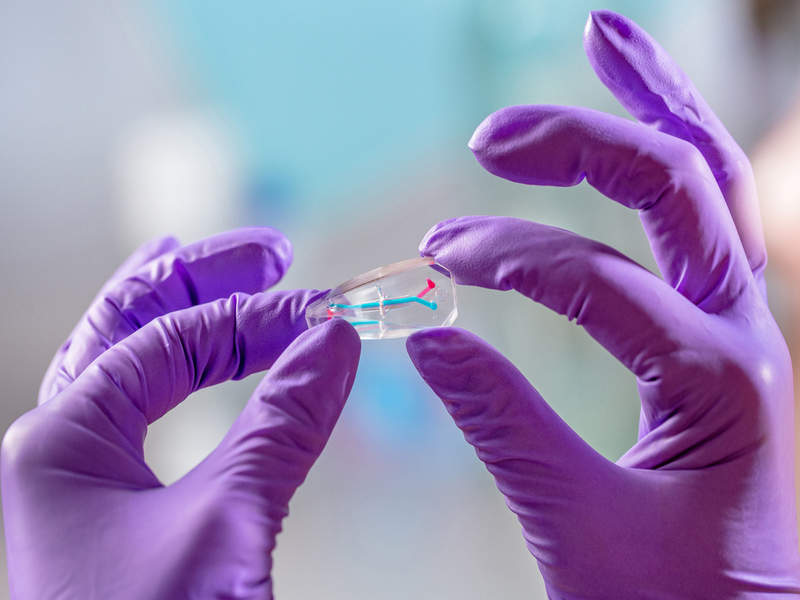

The National Institutes of Health’s (NIH) National Centre for Advancing Translational Sciences (NCATS) has granted a $2m research fund for the use of Emulate’s human Brain-Chip system to develop a fully automated research platform for space.
Studies will involve the use of the firm’s Organs-on-Chips technology to assess the effects of space travel on human brain cells, in turn aiding in the better understanding of neurological diseases on Earth.
Go deeper with GlobalData


Discover B2B Marketing That Performs
Combine business intelligence and editorial excellence to reach engaged professionals across 36 leading media platforms.
The new automated research platform is expected to allow experiments on the International Space Station.
The Brain-Chip, including neuronal and vascular endothelial cells in a living micro-engineered environment, will be analysed under healthy and inflamed states.
NASA contracted the Centre for the Advancement of Science in Space (CASIS) to coordinate the use of the Human Emulation System in space.
The gravity-free environment of the space station is expected to enable the study of human health in microgravity by decoupling the gravitational force from other factors that can affect brain cell function.
US Tariffs are shifting - will you react or anticipate?
Don’t let policy changes catch you off guard. Stay proactive with real-time data and expert analysis.
By GlobalDataThe experiments will focus on the brain function influence by space travel stressors such as hypergravity during launch, decreased oxygen availability, and enhanced stress hormone levels.
Emulate president and chief scientific officer Geraldine Hamilton said: “We can leverage research with Organ-Chips in space and apply the learnings to human health challenges that are experienced on Earth.”
The research will further study the relationship between inflammation and brain function by using the Brain-Chip to investigate the efficacy of anti-inflammatory therapeutic on the blood-brain barrier in space.
The firm will work in collaboration with terrestrial testing platforms designer IRPI and microgravity research firm SpaceTango for developing a space-compatible hardware.
Image: The Emulate Brain-Chip system will be adapted to achieve automation and size requirement for use in space. Photo: courtesy of Business Wire.



