
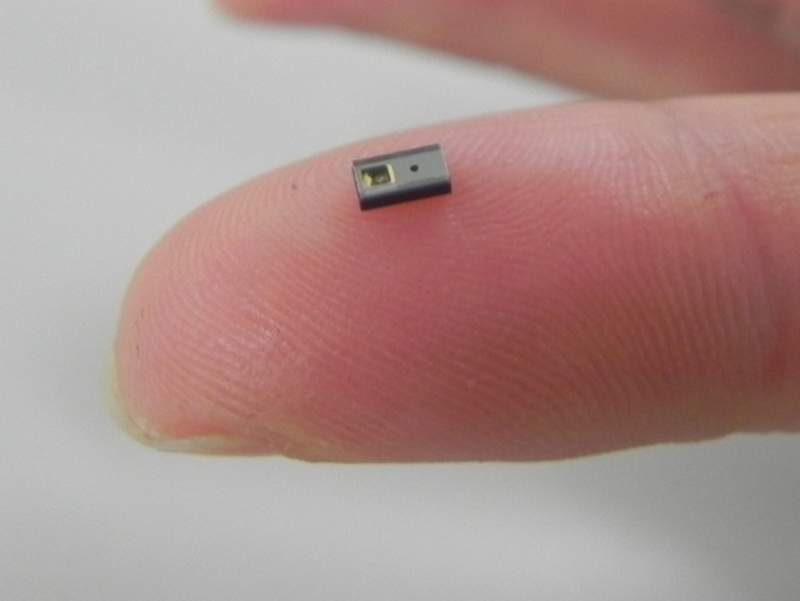

Japanese electronics and ceramics manufacturer Kyocera has developed one of the smallest ever optical blood-flow sensors to measure volume of blood flow in subcutaneous tissue.
The company has used its experience in miniaturisation technology to develop the sensor which is 1mm high, 1.6mm in length and 3.2mm in width.
Go deeper with GlobalData


Discover B2B Marketing That Performs
Combine business intelligence and editorial excellence to reach engaged professionals across 36 leading media platforms.
The sensor has been developed as an integrated package consisting the laser diode and photodiode in a single ceramic package.
Its high-signal-to-noise ratio (S/N), small size and low-power consumption makes the sensor suitable to be installed into small devices such as mobile phones and wearable devices which can then be placed in contact with an ear, finger or forehead to measure blood-flow in subcutaneous tissue.
When light is reflected on blood within a blood vessel, the frequency of light tends to vary and characteristically increases with an increase in blood flow, which is termed as a frequency or Doppler shift according to the blood-flow velocity.
The newly developed sensor uses the relative shift in frequency and strength of the reflected light to measure blood-flow volume.
US Tariffs are shifting - will you react or anticipate?
Don’t let policy changes catch you off guard. Stay proactive with real-time data and expert analysis.
By GlobalDataThe analysis of blood-flow can be done by implanting the sensor in music-playing earbuds which monitors stress levels or orthostatic hypotension while playing music.
Sensor fitted in wearable device can aid in preventing dehydration, heatstroke or altitude sickness by detecting changes in blood flow and send notifications for rehydration when required.
Image: Kyocera's optical blood-flow sensor. Photo: courtesy of Business Wire.



