
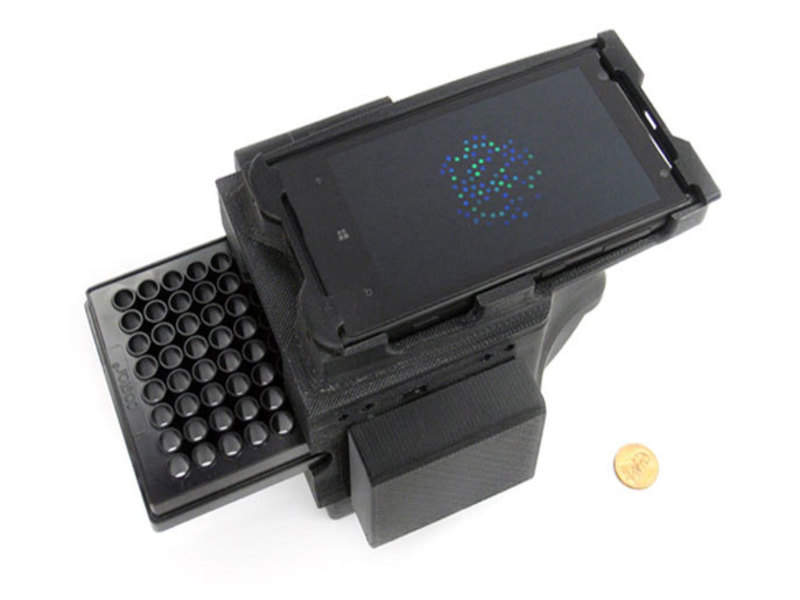

The researchers at University of California, Los Angeles (UCLA) in the US have developed a new technique to identify the presence of DNA biomarkers of a disease using cellphone technology.
The new method utilises the sensors and optics of cellphones to interpret light generated by a new detector dye mixture that is designed to report the presence of DNA molecules with a bright signal.
Go deeper with GlobalData


Discover B2B Marketing That Performs
Combine business intelligence and editorial excellence to reach engaged professionals across 36 leading media platforms.
The standard diagnostic tests require amplification of the number of nucleic acids, as the samples consist of very small amounts of nucleic acids related to a disease.
The research conducted by UCLA entities, the Henry Samueli School of Engineering and Applied Science, the California NanoSystems Institute and the David Geffen School of Medicine, worked towards addressing this concern with low-cost optical detection.
The researchers used intercalator dyes, which are small changes observed in light emitted from DNA-associated molecules, to detect DNA amplification.
The UCLA team has then discovered a new dye / cellphone reader system combination to stabilise the dyes and generate enhanced fluorescent signal above the background light level.
The results achieved by the cellphone based detection methods are found to be comparable to existing costly equipment.
A field-portable fiber optic bundle has been developed to identify the light generated by dyes associated with amplified DNA, while the samples are in standard laboratory containers.
The fibers then directed the signal from the container to a precise location of the camera sensor area.
The researchers used the loop-mediated isothermal amplification process (LAMP) to demonstrate the new technique utilising lambda phage DNA as the target molecule, with plans to further adapt the assay to other complex clinical samples and nucleic acids.
Image: The combined dye / cellphone reader system. Photo: courtesy of Dino Di Carlo / UCLA.


