

Researchers from the University of Washington (UW) in the US have developed a backscatter system to wirelessly monitor extremely low power sensors.
The long-range system can transmit data across distances of up to 2.8km and is expected to enable development of knee and skin patches that could collect useful data.
Go deeper with GlobalData


Discover B2B Marketing That Performs
Combine business intelligence and editorial excellence to reach engaged professionals across 36 leading media platforms.
Designed to use reflected radio signals, the system is said to transmit data at a low cost and with 1,000 times less power compared to current technologies.
Paul G Allen School of Computer Science and Engineering associate professor Shyam Gollakota said: “Until now, devices that can communicate over long distances have consumed a lot of power.
“The trade-off in a low-power device that consumes microwatts of power is that its communication range is short.
“Now we’ve shown that we can offer both, which will be pretty game-changing for a lot of different industries and applications.”

US Tariffs are shifting - will you react or anticipate?
Don’t let policy changes catch you off guard. Stay proactive with real-time data and expert analysis.
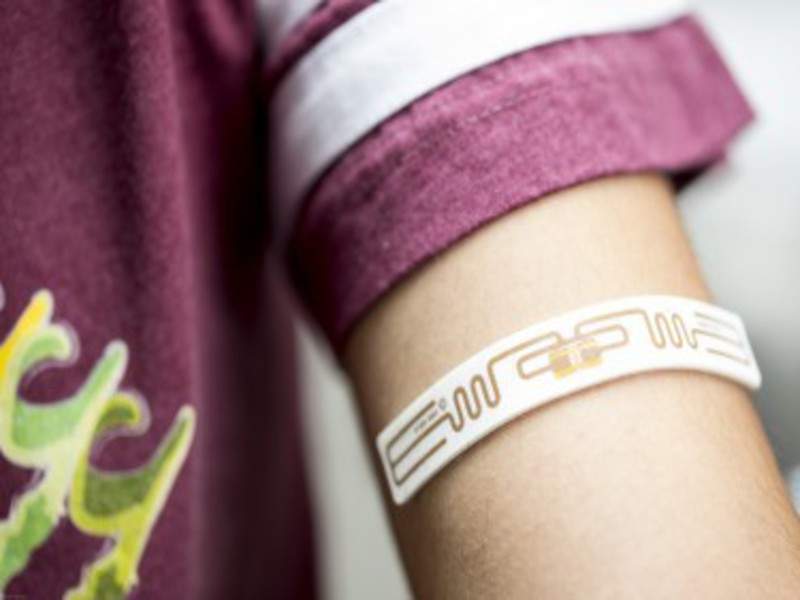
By GlobalDataDuring testing, the researchers built a prototype contact lens and epidermal patch that used long-range backscatter to transmit information across a 3,300ft² atrium.
The new system comprises a radio signal-emitting source, sensors to encode information in the signal’s reflection, and a low-cost receiver that decodes the information.
The sensors cost 10-20 cents and have a variety of applications such as in medical devices to wirelessly transmit information on a patient’s heart condition or when monitoring pollution and noise.
A new type of modulation called 'chirp spread spectrum' has been added to the backscatter design to obtain greater sensitivity and decode backscattered signals across greater distances.
UW intends to commercialise the system within six months through a spin-out company, Jeeva Wireless, which was founded by its team of computer scientists and electrical engineers.
Image: The research team built a flexible epidermal patch prototype that could be used to collect and wirelessly transmit useful medical data. Photo: courtesy of the University of Washington.



