
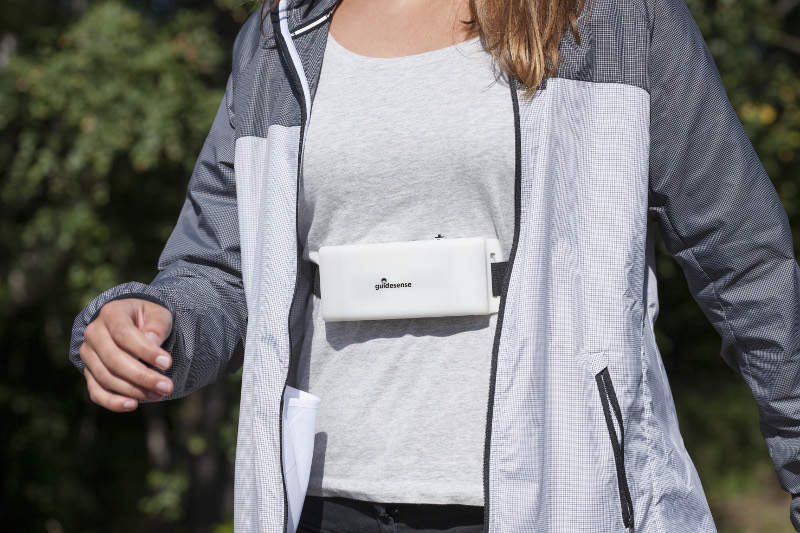

A wearable assistive device designed by the VTT Technical Research Centre of Finland will enable the visually impaired to move freely and safely by sensing their surroundings.
The device is worn like a heart rate monitor and consists of a flexible belt and sensor.
Go deeper with GlobalData


Discover B2B Marketing That Performs
Combine business intelligence and editorial excellence to reach engaged professionals across 36 leading media platforms.
It is part of a two-year Guide the Radar project funded by VTT and Tekes.
The mechanism of action of the device is based on a radar system developed by VTT.
VTT senior scientist Tero Kiuru said: "The novel aspect lies in wearable sensor device which functions based on radio waves, so that the signal passes through normal clothing.”
The radar senses the obstacles lying on the way of the person and then conveys the information to the user in the form of vibrations or voice feedback.
However, it does not effectively sense objects like thin branches and bushes.
The radar has obtained clinical validation after undergoing device trials involving a test group of 25 visually impaired people, of whom 14 were blind, seven partially sighted and four were deaf-blind.
The trials were approved by the National Supervisory Authority for Welfare and Health (Valvira), in which VTT partnered with Kuopio University Hospital and the Finnish Federation of the Visually Impaired (FFVI).
Kiuru added: "A clear majority of the testers felt that the radar improved their ability to perceive their environment and increased their self-confidence when moving around.”
Most of the trial subjects experienced efficacy of the device in sensing the surrounding which can help in ensuring safe and improved mobility of the visually impaired.
However, some of the subjects were dissatisfied with its distance control and vibration-based feedback.
Researchers are continuing to test the device on selected test users for its further development.
Image: Wearable assistive device for visually impaired. Photo: courtesy of VTT.



