
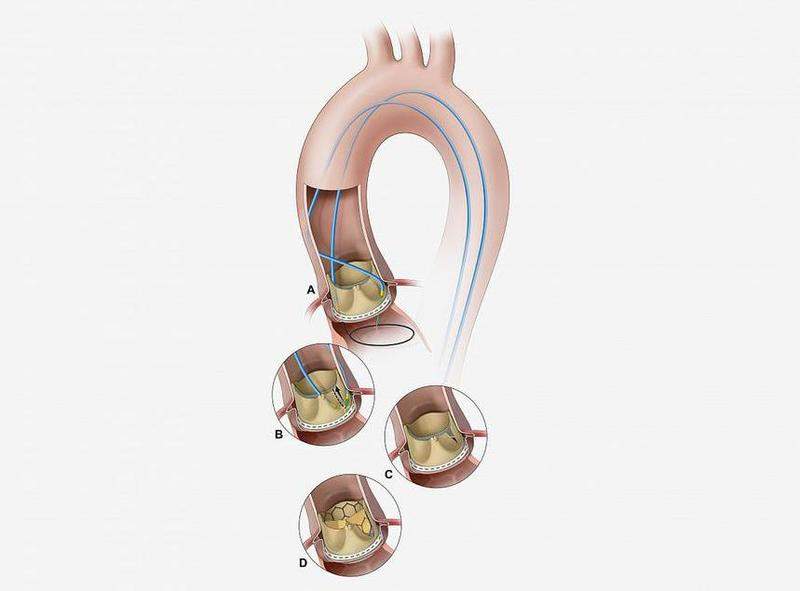
Researchers at the National Institutes of Health (NIH) have developed a new approach to prevent the coronary artery obstruction complication that is common during transcatheter aortic valve replacement (TAVR) procedures.
The new ‘Bioprosthetic Aortic Scallop Intentional Laceration to prevent Iatrogenic Coronary Artery obstruction’ (BASILICA) technique is devised for high-risk patients.
Go deeper with GlobalData


Discover B2B Marketing That Performs
Combine business intelligence and editorial excellence to reach engaged professionals across 36 leading media platforms.
TAVR is performed to address aortic valve stenosis and is carried out by inserting a catheter through the leg’s femoral artery up to the heart. This procedure is considered as an effective and less invasive option for elderly or frail patients.
According to the NIH, coronary artery obstruction was fatal for more than 50% of the patients who developed the complication during the TAVR.
To address the complication and enhance safety, Jaffar Khan at the NIH’s National, Heart, Lung, and Blood Institute (NHLBI) developed BASILICA, where an electrified wire is weaved through a catheter to avoid the blockage of a coronary artery by splitting the original leaflet in two.
Scientists successfully tested the new technique in seven gravely ill patients who did not have any other care options.

US Tariffs are shifting - will you react or anticipate?
Don’t let policy changes catch you off guard. Stay proactive with real-time data and expert analysis.
By GlobalDataNHLBI Division of Intramural Research senior investigator Robert Lederman said: “All patients had a successful TAVR with no coronary obstruction, stroke or any major complication.
“They were doing well as they reached the 30-day-mark after the procedure.”
A multi-centre early feasibility study has been launched in January this year to further assess BASILICA, which is expected to minimise the number of fatalities caused due to heart valve disease.
Researchers hope the technique will eventually help reduce the number of deaths from heart valve disease.



