
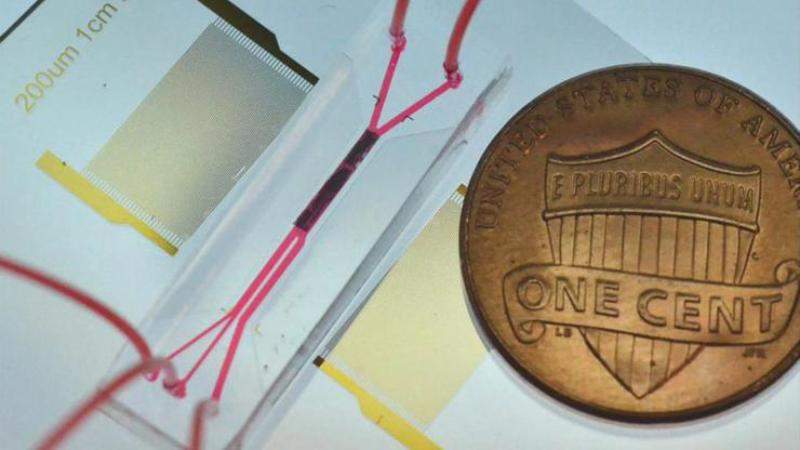
Researchers from Duke University, Massachusetts Institute of Technology (MIT) and Singaporean Nanyang Technological University have found that a microfluidic platform based on sound waves can rapidly carry out liquid biopsies.
The study showed that the technology can separate circulating tumour cells (CTCs) from 7.5ml of a blood sample with at least an 86% efficiency within one hour.
Go deeper with GlobalData


Discover B2B Marketing That Performs
Combine business intelligence and editorial excellence to reach engaged professionals across 36 leading media platforms.
CTCs contain rich information about tumours, such as the tumour’s type, physical characteristics and genetic mutations, which can be used for prognosis and to determine the effectiveness of some treatments.
Fast and efficient extraction of CTCs and their growth is expected to enable a liquid biopsy that can assess individual CTC profiling to facilitate diagnosis, prognosis and treatment decisions.
However, existing techniques to separate the tumour cells from normal blood cells are said to lack efficiency, consume time and are designed only for certain cancer types.
To address these challenges, the researchers intend to use the acoustic microfluidic platform technology to create a gentle, contact-free test via an inexpensive, disposable chip.
US Tariffs are shifting - will you react or anticipate?
Don’t let policy changes catch you off guard. Stay proactive with real-time data and expert analysis.
By GlobalDataDuke University Mechanical Engineering and Materials Science professor William Bevan said: “Biopsy is the gold standard technique for cancer diagnosis, but it is painful and invasive and is often not administered until late in the cancer’s development.
“With our circulating tumour cell separation technology, we could potentially help find out, in a non-invasive manner, whether the patient has cancer, where the cancer is located, what stage it’s in, and what drugs would work best.”
According to the researchers, the risk of damage to CTCs is decreased with the new approach because each tumour cell is exposed to the sound waves only for a fraction of a second.
The sound waves also eliminate the need for labelling or surface modification, allowing retaining of natural functions and states of the cells.
Currently, researchers are working towards further developing the technology to enhance its speed and efficiency, while determining its feasibility in various culturing and profiling projects to validate its clinical use.



