
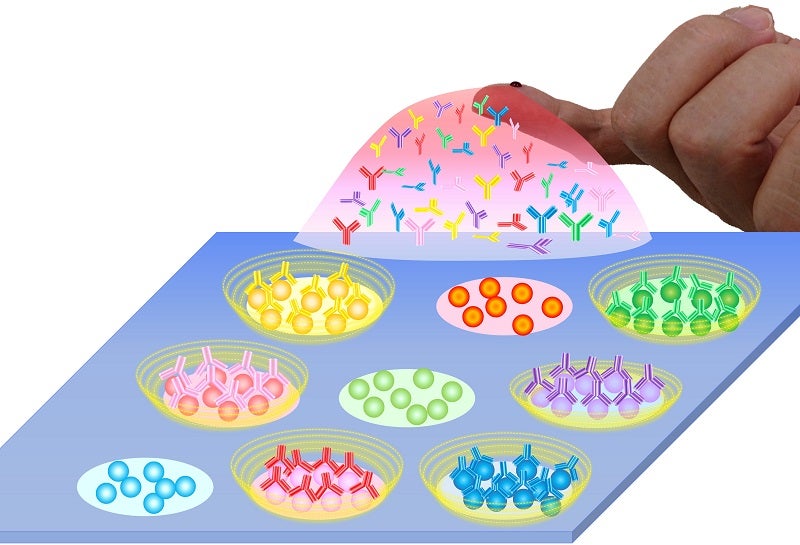
Researchers at Japan’s RIKEN Center for Emergent Matter Science (CEMS) have developed a diagnostic system that is capable of measuring antibodies against the Covid-19 virus rapidly and sensitively.
Antibodies in the blood can give protection from the SARS-CoV-2 virus.
Go deeper with GlobalData


Discover B2B Marketing That Performs
Combine business intelligence and editorial excellence to reach engaged professionals across 36 leading media platforms.
The diagnostic system is expected to enable precise SARS-CoV-2 vaccine efficacy testing at medical facilities.
Yoshihiro Ito at Riken CEMS led the new research. Along with colleagues, Ito has already developed a test kit for the diagnostic system using a microchip that contains more than 40 different allergens immobilised on it.
They have now expanded their diagnostic tools for use in a system that immobilises several key SARS-CoV-2 proteins.
This allows the presence of virus antibodies to be detected automatically.
US Tariffs are shifting - will you react or anticipate?
Don’t let policy changes catch you off guard. Stay proactive with real-time data and expert analysis.
By GlobalDataIto said: “Standard quantitative analysis of antibodies usually requires a half millilitre of blood drawn from one of your arms, which is a lot!
“But in our system, all that is needed is a small drop of blood from the fingertip, and the sensitivity of the system is 500 times higher than that of conventional immunochromatography, meaning that detection is possible even when the number of antibodies is very low.”
The system can be operated easily by dropping human blood serum onto the chip and pressing the start button. In about 30 minutes, the reaction process, washing, and antibody detection are automatically carried out.
In the process, a substance that reacts to light is initially coated on a plastic microchip, and a sample liquid with the protein of interest is dropped in the form of a spot onto the microchip.
The chip is then exposed to ultraviolet light, which immobilises the proteins.
The researchers used this method to develop a microarray chip upon which key SARS-CoV-2 proteins are fixed.
Antibodies in the blood serum release light after they bind to the viral proteins on the chip. A CCD camera will be used to measure the amount of emitted light.
Ito further added: “This system is practical to use and will enable precision testing at any medical facility, making it easier to quickly determine on-site whether or not vaccination is necessary. It can also be used to conduct epidemiological surveys in preparation for future pandemics.”



