
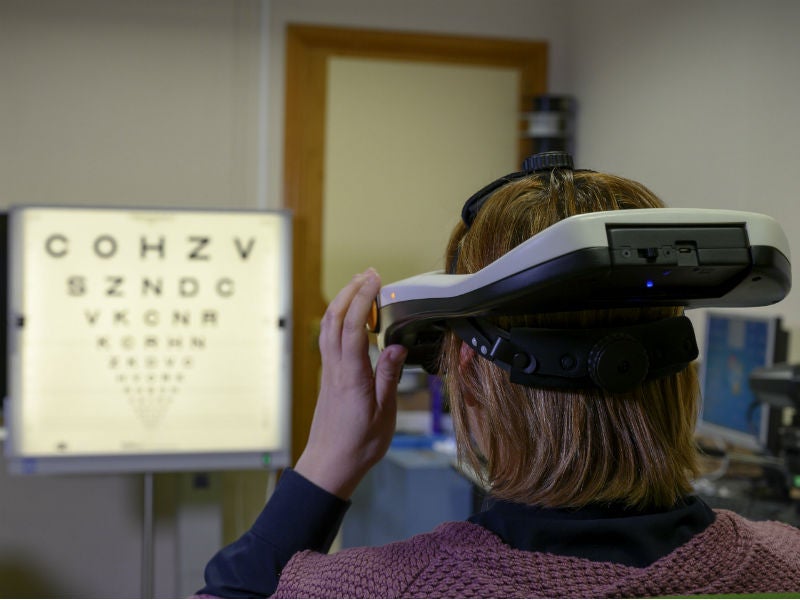
Scientists from the Spanish National Research Council (CSIC) have developed a wearable visual simulator, called SimVis, which enables patients to experience how their vision will improve after having cataract surgery.
SimVis a lightweight binocular visual simulator that is autonomous and is worn like a helmet. The device is the first of its kind and has been designed to allow patients and surgeons to see the effects of an intraocular multifocal lens, which allows seeing at different distances, in a realistic way before the lens is implanted.
Go deeper with GlobalData


Discover B2B Marketing That Performs
Combine business intelligence and editorial excellence to reach engaged professionals across 36 leading media platforms.
The details surrounding the validation of the new device have been published in the latest issue of Scientific Reports.
Multifocal lenses are used in cataract surgery to replace the lens when it has lost its transparency or to correct long-sightedness caused by loss of elasticity in the eye lens.
There are many different lenses available and choosing which one a patient needs depends on their preference and tolerance.
CSIS researcher Susana Marcos said: “The possibility of the patient experimenting with vision using a multifocal lens before the surgery is very attractive to reduce uncertainty and to manage expectations.”
US Tariffs are shifting - will you react or anticipate?
Don’t let policy changes catch you off guard. Stay proactive with real-time data and expert analysis.
By GlobalDataMarcos’ team at the Visual Optics and Biophotonics Laboratory in Madrid has been working to develop technologies of simultaneous vision simulation for years. The team’s aim has been to evaluate visual quality with new designs of multifocal lenses before they are implanted or manufactured.
Marcos added: “Visual simulators are an ideal technique to provide patients with a new realistic experience of multifocality before the implantation of a new intraocular lens. In addition, if the simulator is miniaturized and has a more practical design than the ones currently available in the market, benefits could multiply.”
The researchers tested and validated the simulator’s realism during a study in a group of patients. They compared the visual acuity obtained at different distances through a commercial trifocal lens and through the same lens simulated by a spatial light modulator, which is another simulating technology, and by SimVis.
CSIC researcher and first author of the article María Viñas said: “The response to multifocality depends on the subjects, but the real trifocal lens and the simulated one offered the same visual response through-focus in each patient.”
The visual simulator can be wirelessly controlled by a mobile app or a tablet. The program has the ability to control the device’s lenses as well as track the functional tests conducted on each patient in any location.



