
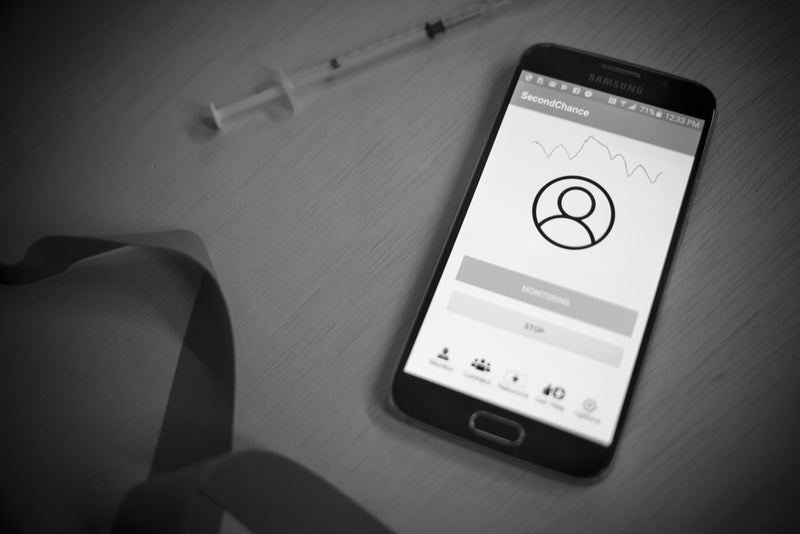
Researchers at the University of Washington have developed a smartphone app, dubbed Second Chance, to detect opioid overdose and facilitate necessary intervention.
According to the National Institute on Drug Abuse, more than 115 people die in the US due to opioid overdose, which is characterised by the slowing down or cessation of breathing.
Go deeper with GlobalData


Discover B2B Marketing That Performs
Combine business intelligence and editorial excellence to reach engaged professionals across 36 leading media platforms.
If detected in time, these symptoms can be reversed using a drug called naloxone.
The new app uses sonar to monitor breathing rates and identify the occurrence of an overdose. It sends inaudible sound waves from the phone to people’s chests and then tracks how the waves return to the phone in order to check for specific breathing patterns.
When tested, Second Chance was able to accurately detect overdose-related symptoms in 90% of the cases and tracked someone’s breathing from up to 3ft away.
Upon detecting decreased or absent breathing, the app will send an alarm asking the user to interact with it prior to contacting a friend or emergency services.
US Tariffs are shifting - will you react or anticipate?
Don’t let policy changes catch you off guard. Stay proactive with real-time data and expert analysis.
By GlobalDataBesides breathing, the app is designed to monitor the user’s movements.
University of Washington Paul G Allen School of Computer Science & Engineering associate professor Shyam Gollakota said: “The idea is that people can use the app during opioid use so that if they overdose, the phone can potentially connect them to a friend or emergency services to provide naloxone.
“Here we show that we have created an algorithm for a smartphone that is capable of detecting overdoses by monitoring how someone’s breathing changes before and after opioid use.”
The university’s team formed an alliance with Insite supervised injection facility in Canada to obtain real-world data for designing and testing the algorithm behind the app.
Participants at Insite wore breathing rate-tracking monitors on their chests and were observed by the researchers before and after drug administration.
Out of the 94 participants, 47 experienced a breathing rate of seven breaths per minute or slower, 49 stopped breathing for a significant period and two people had an overdose event that required treatment.
To test the app in actual opioid overdose events, the researchers partnered with anesthesiology teams at UW Medical Center to simulate overdoses.
The algorithm demonstrated the ability to correctly predict 19 out of the 20 simulated overdoses.
Currently, the research team is seeking the US Food and Drug Administration (FDA) approval for the app, with plans to commercialise it through the university spinout, Sound Life Sciences.



