
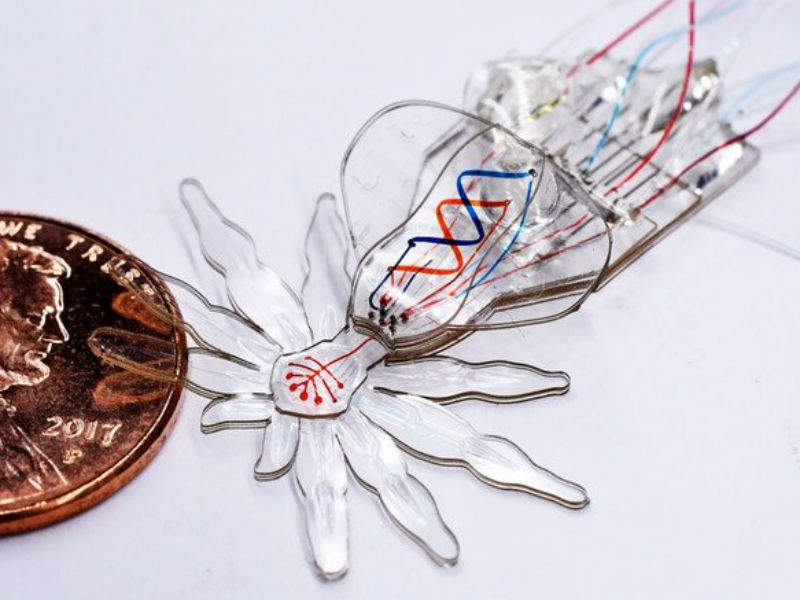
Researchers at Harvard University’s Wyss Institute for Biologically Inspired Engineering, Harvard John A. Paulson School of Engineering and Applied Sciences (SEAS) and Boston University have developed an integrated fabrication process that has enabled the design of a soft micro-robot with delicate surgical applications.
To demonstrate the technology, the researchers created the millimetre-scale robotic soft spider from a single elastic material with body-shaping, motion, and colour features. The micro-robot was inspired by the millimetre-sized Australian peacock spider and has micrometre-scale features.
Go deeper with GlobalData


Discover B2B Marketing That Performs
Combine business intelligence and editorial excellence to reach engaged professionals across 36 leading media platforms.
A study describing the process of making the robot has been published in Advanced Materials.
The team refer to the robot as a Microfluidic Origami for Reconfigurable Pneumatic/Hydrolic (MORPH) device.
Wyss Institute founding director Dr Donald Ingber said: “The MORPH approach could open up the field of soft robotics to researchers who are more focused on medical applications where the smaller sizes and flexibility of these robots could enable an entirely new approach to endoscopy and microsurgery.”
Boston University assistant professor and co-author of the study Dr Shelia Russo said: “The smallest soft robotic systems still tend to be very simple, with usually only one degree of freedom, which means that they can only actuate one particular change in shape or type of movement.

US Tariffs are shifting - will you react or anticipate?
Don’t let policy changes catch you off guard. Stay proactive with real-time data and expert analysis.
By GlobalData“By developing a new hybrid technology that merges three different fabrication techniques, we created a soft robotic spider made only of silicone rubber with 18 degrees of freedom, encompassing changes in structure, motion, and colour, and with tiny features in the micrometre range.”
Wyss Institute co-leader of the Bioinspired Soft Robotics platform Dr Robert Wood added: “In the realm of soft robotic devices, this new fabrication approach can pave the way towards achieving similar levels of complexity and functionality on this small scale as those exhibited by their rigid counterparts. In the future, it can also help us emulate and understand structure-function relationships in small animals much better than rigid robots can.”



