
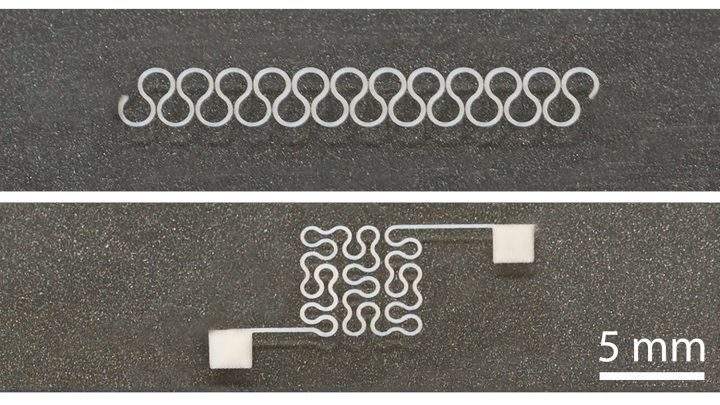
Scientists at North Carolina State University have developed silver nanowires that can be used to print circuits on flexible, stretchable materials that could be used in medical devices.
The paper, ‘Electrohydrodynamic Printing of Silver Nanowires for Flexible and Stretchable Electronics’, published in Nanoscale, suggests that silver nanowires could be a significant breakthrough in wearable medical technology. Silver nanoparticles can be used to print circuits, but they are more brittle and less conductive than nanowires. Conventional techniques for printing nanowires have proven ineffective, as they often clog the printing nozzles.

Discover B2B Marketing That Performs
Combine business intelligence and editorial excellence to reach engaged professionals across 36 leading media platforms.
“Our approach uses electrohydrodynamic printing, which relies on electrostatic force to eject the ink from the nozzle and draw it to the appropriate site on the substrate,” said Jingyan Dong, co-author of the study and an associate professor at the university’s Edward P. Fitts department of industrial and systems engineering.
“This approach allows us to use a very wide nozzle–which prevents clogging–while retaining very fine printing resolution.”
The team intends to test the technology by creating prototypes of a glove with an internal heater and a wearable electrode for use in electrocardiography. North Carolina State University has filed a provisional patent for the printing technique, which has the potential for use in older medical devices. Yong Zhu and Matt Shipman, who both worked on the project, have previously worked on a wearable sensor to measure skin hydration, that consists of two electrodes made of an elastic polymer composite that contains conductive silver nanowires.
“Given the technique’s efficiency, direct writing capability, and scalability, we’re optimistic that this can be used to advance the development of flexible, stretchable electronics using silver nanowires – making these devices practical from a manufacturing perspective,” said Zhu.

US Tariffs are shifting - will you react or anticipate?
Don’t let policy changes catch you off guard. Stay proactive with real-time data and expert analysis.
By GlobalData“In addition, the solvent we use is both nontoxic and water-soluble,” said Zheng Cui, a PhD student at North Carolina State and lead author of the paper. “Once the circuit is printed, the solvent can simply be washed off.”
The research was funded by grants from the National Science Foundation.


