
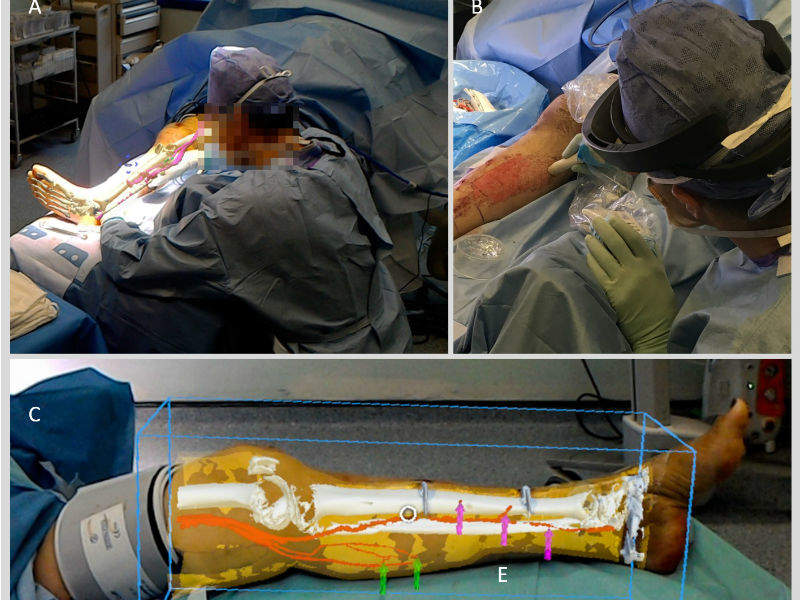
Surgeons at St Mary’s Hospital in London claim devices such as the Microsoft HoloLens are the future of surgery and demonstrated how they use the technology to make procedures more efficient for both the practitioner and patient.
The surgeons have been using the HoloLens glasses to aid them in perforator flap surgery, a form of reconstructive surgery that involves taking large areas of skin and/or subcutaneous fat from one part of a patient’s body and using it to reconstruct another area.
Go deeper with GlobalData


Discover B2B Marketing That Performs
Combine business intelligence and editorial excellence to reach engaged professionals across 36 leading media platforms.
One of the main challenges of perforator flap surgeries is that they require successful attachment of the skin graft to an existing blood supply. This involves scanning and imaging the wounded region prior to surgery to predict the best areas for incision in relation to useable blood vessel placement. The HoloLens glasses make this process more efficient by allowing surgeons to view the patient’s scans directly onto the limb in question and marking the patient more precisely.
St Mary’s Hospital surgeon Mathew Ives said: “The HoloLens makes a difference because you can mark up a patient in advance and have a good idea of where the blood vessels are. This saves time and stops the unnecessary cutting of blood vessels.”
Dr Phillip Pratt from Imperial College London thought of the concept of using Microsoft’s virtual reality tools for surgery two years ago. He has since overseen the use of the HoloLens device at St Mary’s College Hospital in around ten operations over the past ten months.
He said: “Machines such as MRI scanners and CT scanners give us so much detail but HoloLens allows us to use that detail to a greater advantage. We’re using the information in a more effective way.
“At the moment, a surgeon will come into theatre and have to view scans on a 2D screen and try to reconstruct the image on the patient’s leg in their own head. With the HoloLens everything is just there in front of you.”
One of the key advantages of the wearable system is that it can be used without compromising the sterility of the environment as the device is operated with hand gestures and voice commands rather than touch.
However, the technology does has several drawbacks. The image the HoloLens projects does not automatically ‘snap’ to a patient’s limb and therefore does not account for patient movement. Additionally, it is currently only used for marking up patients and not during the actual surgery; the time saved is not greatly significant. The current design of HoloLens means the glasses are too heavy to be worn throughout an entire operation.
Pratt expects that these issues will be resolved as the device is developed further and claims that using HoloLens for medical purposes is a pioneering technique. He added: “I think people will look back at it in the future and think this is the point when the game changed.”



