
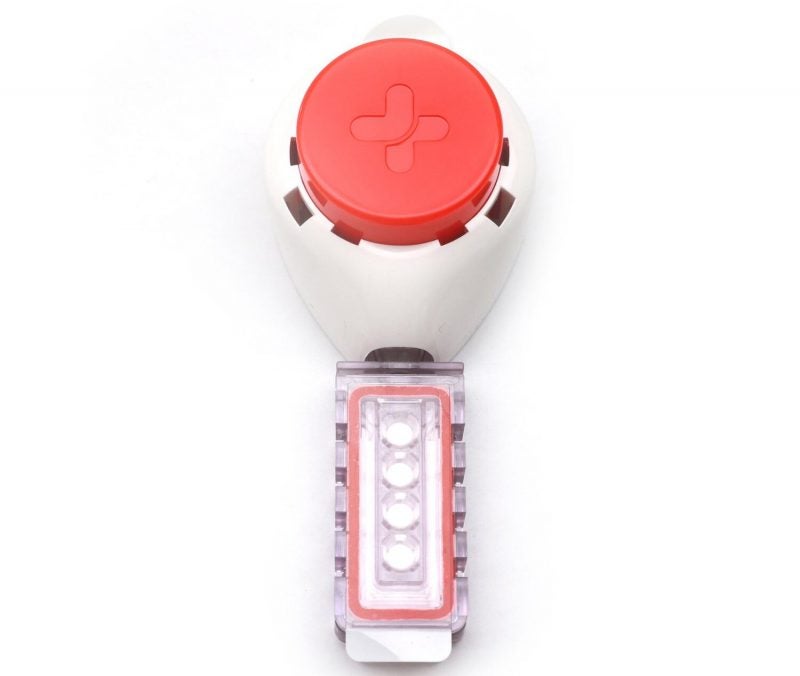
Researchers at the University of Washington (UW) School of Medicine in Seattle, US, have reported that in a study the Tasso device to draw blood samples in the at-home setting was found to be useful for measuring antibodies against SARS-CoV-2.
Named Tasso-SST blood sampling kit, the device utilises a gentle vacuum to collect blood from capillaries under the skin in a few minutes.
Go deeper with GlobalData


Discover B2B Marketing That Performs
Combine business intelligence and editorial excellence to reach engaged professionals across 36 leading media platforms.
To obtain a blood sample with the Tasso-SST blood sampling kit, a user has to clean an area on the upper arm and attach the device, which comes with an adhesive patch.
The user can then push a button on the device to release a small, spring-loaded lancet that pierces the skin.
The device creates a vacuum that aids in drawing blood through the needle prick from the network of capillary blood vessels, located under the skin, in a few minutes.
The capillary blood is collected in a tube, which can be removed, closed with a lid and sent to a laboratory for evaluation.
According to the findings, the device could be used by patients to draw blood at home for various tests that presently require them to go to a clinic or laboratory, scientists noted.
The study enrolled 56 subjects who had previously been infected by SARS-CoV-2 and recovered.
The healthy controls in the study included 33 individuals without a history of SARS-CoV-2 infection.
The blood test was used to check if the immune systems of recovered subjects had created sufficient antibodies against the virus and could be used for donation to aid in treating subjects with current infections.
For the study, blood was collected three ways: either by self-collection or under supervision using a Tasso kit or using the standard technique of a phlebotomist collecting a sample drawn from a vein.
All the blood samples were tested simultaneously for the antibodies using the EuroImmun anti-SARS-CoV-2 S1 IgG assay.
No substantial differences between the samples obtained by the three methods were found in the study, the university noted.
UW Department of Laboratory Medicine and Pathology associate professor Dr Chihiro Morishima said: “There was nearly perfect correlation between the results from the venous blood and the capillary blood samples.
“This was a ‘proof-of-principle’ study. It shows that the approach can work. But we need to verify its accuracy and reliability for other tests before it can be used routinely for clinical care or research.”



