
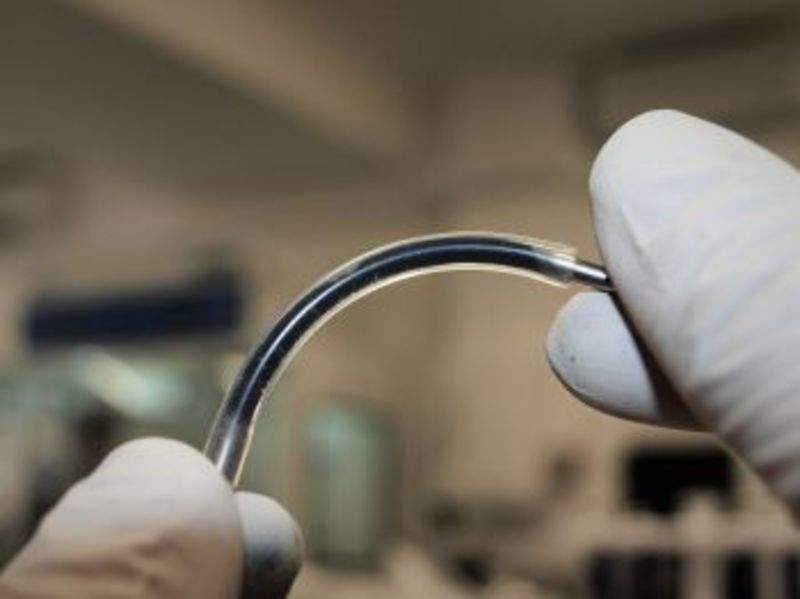
Physicists from the University of Sussex in the UK have developed a new wearable sensor to facilitate remote monitoring of heart and breathing rates in babies.
Researchers created the new liquid-based sensors from the emulsion of graphene, which is a two-dimensional, flexible, and conductive material made from carbon atoms.
Go deeper with GlobalData


Discover B2B Marketing That Performs
Combine business intelligence and editorial excellence to reach engaged professionals across 36 leading media platforms.
The conductivity of the liquid graphene embedded in the new device is said to change with even small stretching of a channel or tube holding the liquid, enabling tracking of the respiration rates and pulses.
As the new sensors will be designed into wireless and non-invasive wearable devices, they are expected to eliminate the need for heavy sensors that require being attached to a monitor by wires.
It is said that the sensors will be sensitive enough to detect the smallest signals when attached to the body, and the obtained data is automatically transferred to smartphones.
University of Sussex School of Mathematics and Physical Sciences professor Alan Dalton said: “Using the conducting liquid emulsions we have developed, we will produce cheap, wearable sensors based on graphene.
“We will eventually have a suit that the baby can wear, which will read out all vital information wirelessly.
“In the laboratory, we have created a sensor that has the potential to drastically improve early detection of life-threatening symptoms such as sleep apnea or cardiac arrhythmia, where constant monitoring with conventional equipment is challenging outside of the hospital environment.”
A prototype of the wearable sensor has been developed and the researchers anticipate a commercial launch over the coming two to four years.



