
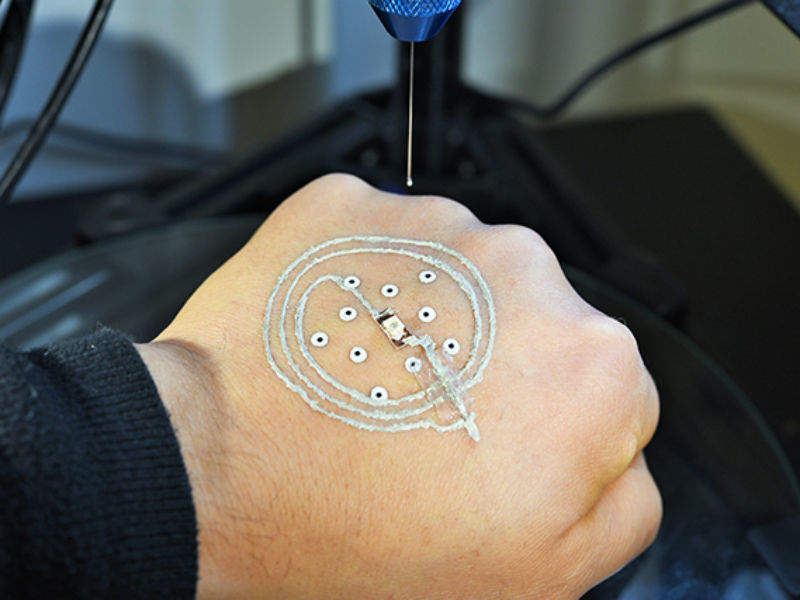
Researchers at the University of Minnesota in the US have developed technology capable of directly 3D printing biological cells and electronics on skin in real-time.
The portable, customised 3D printer is expected to aid in developing new medical treatments for wound healing and allow direct printing of grafts to treat skin disorders.
Go deeper with GlobalData


Discover B2B Marketing That Performs
Combine business intelligence and editorial excellence to reach engaged professionals across 36 leading media platforms.
In addition, the low-cost technology could help soldiers if used to create temporary sensors capable of detecting chemical or biological agents. It could also aid in the 3D printing of solar cells that can charge electronics.
University of Minnesota Mechanical Engineering associate professor Michael McAlpine said: “We are excited about the potential of this new 3D printing technology using a portable, lightweight printer costing less than $400.
“We imagine that a soldier could pull this printer out of a backpack and print a chemical sensor or other electronics they need, directly on the skin. It would be like a ‘Swiss Army knife’ of the future with everything they need all in one portable 3D printing tool.”
The approach works by placing temporary markers on the skin, which is then scanned. According to the team, the technique allows the printer to adjust to small body movements by using computer vision.

US Tariffs are shifting - will you react or anticipate?
Don’t let policy changes catch you off guard. Stay proactive with real-time data and expert analysis.
By GlobalDataMcAlpine added: “This printer can track the hand using the markers and adjust in real-time to the movements and contours of the hand, so printing of the electronics keeps its circuit shape.”
Instead of standard inks that require high temperatures that may burn the skin, the new method employs an ink made of silver flakes that cure and conduct at room temperature.
The printed electronics/cells can be removed by peeling with tweezers or washing with water.
When tested on a mouse skin wound, the technique is reported to have successfully 3D printed biological cells onto the wound.



