
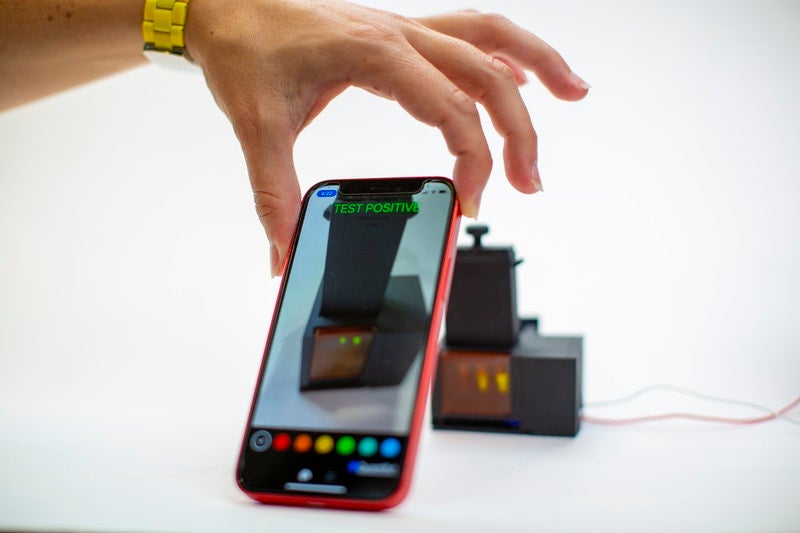
Wyss Institute in the US has announced a new low-cost diagnostic test that allows users to test themselves for multiple SARS-CoV-2 strains at home.
Called Minimally Instrumented SHERLOCK (miSHERLOCK), the new test was created by researchers at the Wyss Institute for Biologically Inspired Engineering at Harvard University, the Massachusetts Institute of Technology (MIT) and several hospitals in Boston. It allows users to test themselves for the virus and its variants at home using a saliva sample.
Go deeper with GlobalData


Discover B2B Marketing That Performs
Combine business intelligence and editorial excellence to reach engaged professionals across 36 leading media platforms.
Provided by the easy-to-use CRISPR-based diagnostic device, results can be read and verified by an accompanying smartphone app within one hour.
Experiments found that the device could successfully differentiate between three different SARS-CoV-2 variants and can be reconfigured for identifying additional variants, such as the Delta variant.
A 3D printer and commonly available components can be used for assembling the device.
Wyss Institute and MIT postdoctoral fellow Helena de Puig said: “miSHERLOCK eliminates the need to transport patient samples to a centralised testing location and greatly simplifies the sample preparation steps, giving patients and doctors a faster, more accurate picture of individual and community health, which is critical during an evolving pandemic.”
US Tariffs are shifting - will you react or anticipate?
Don’t let policy changes catch you off guard. Stay proactive with real-time data and expert analysis.
By GlobalDataUsing CRISPR’s ‘molecular scissors’, SHERLOCK snips DNA or RNA at specific locations and cuts other pieces of DNA in the surrounding area.
The researchers also created additional SHERLOCK assays for targeting a panel of viral mutations in Spike protein sequences that represent Alpha, Beta and Gamma, three of the genetic variants of SARS-CoV-2.
Instead of nasopharyngeal swab samples, they chose to use saliva as their diagnostic source material, as it is easier for users to collect saliva.
According to studies, SARS-CoV-2 can be detected in saliva for a greater number of days after infection, however, unprocessed saliva contains enzymes that degrade various molecules, producing a high rate of false positives.
To solve this problem, the researchers developed a novel technique.
The first step was to add DTT and EGTA chemicals to saliva. They then heated the sample to 95°C for three minutes, deactivated the enzymes producing the false-positive signals and sliced open any viral particles.
They then introduced a porous membrane that was engineered to trap RNA on its surface. After this, the sample could finally be added to the SHERLOCK reaction directly for a result.
The team designed a simple battery-powered device, with a heated sample preparation chamber and unheated reaction chamber, for integrating the saliva sample preparation and the SHERLOCK reaction into one diagnostic.
The diagnostic device was tested using clinical saliva samples collected from 27 Covid-19 patients and 21 healthy patients.
It was found that miSHERLOCK correctly identified Covid-19-positive patients 96% of the time, while patients without the disease were identified 95% of the time.



