
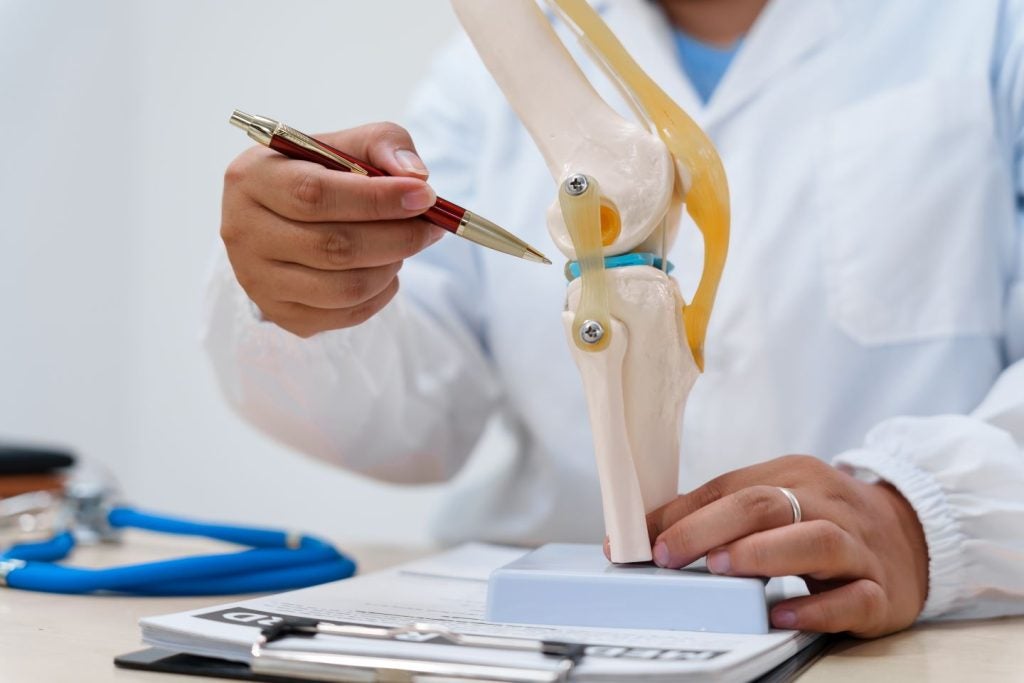
Canada-based ArthroLense and Germany’s Waldemar Link have entered a collaboration, combining their respective technologies with the aim to improve knee surgery outcomes.
Under the non-exclusive agreement, ArthroLense’s ArthroLense 4Di will be combined with Waldemar Link’s LinkSymphoKnee and additional knee implants. ArthroLense 4Di is an augmented reality (AR) and mixed reality surgical navigation system, while LinkSymphoKnee is a primary knee system.
ArthroLense 4Di uses two 3D spatial mapping cameras driven by ArthroLense’s proprietary machine vision and machine learning (ML)-powered software platform, which generates 3D model of the surgical area.
While the collaboration with Waldemar Link will focus on knee revision, the system is suitable for the provision of real-time data and visualisation to surgeons via a viewing portal across a range of orthopaedic surgery indications.
The companies anticipate that their collaboration will increase market awareness and adoption of their respective products and technologies in the US market.
Waldemar Link CEO Peter Willenborg commented: “By integrating our advanced LinkSymphoKnee implant systems with ArthroLense’s visual guidance platform, we are taking a decisive step toward more personalised, predictable, and successful orthopaedic procedures.”
Waldemar Link previously paired up with THINK Surgical, adding its LinkSymphoKnee System to the latter’s proprietary data bank of implant modules, ID-HUB, for use with its TMINI Miniature Robotic System.
The use of technologies such as AR and virtual reality (VR) are beginning to gain a particular foothold in spine surgery. According to GlobalData analysts, these advanced image visualisation approaches serve to enhance both surgical planning and intraoperative guidance to ultimately improve patient care by increasing understanding of anatomy and surgical pathology.
While robotic surgery dominates the conversation around technologic approaches to surgery across a range of indications, AR and VR are viewed as cheaper, more convenient off-the-shelf systems that may be more appropriate for certain healthcare settings, given the negation of annual maintenance costs often associated with robotic surgery systems.
In terms of surgical planning, 3D printing is also playing a growing role, with research indicating that the likes of 3D printed anatomic models and surgical guides may reduce surgical time by a mean of 62 minutes and resulted in cost savings of $3,720 per case. According to GlobalData analysis, the medical 3D printing market will rise from $2bn in sales in 2022 to $4bn in 2026.