
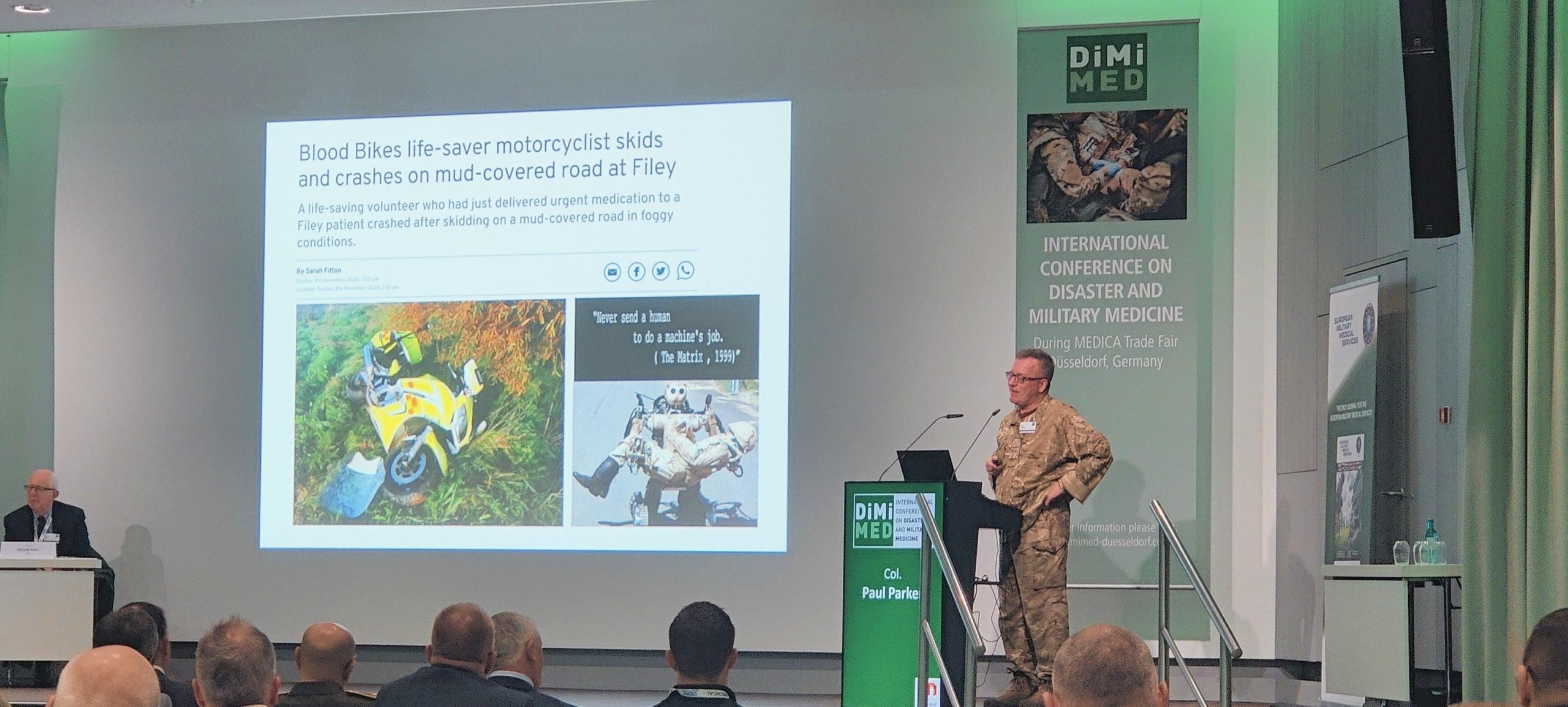
Colonel Paul Parker, orthopaedics consultant at Queen Elizabeth Hospital, Birmingham and the University College, Cork described the future of battlefield medicine at MEDICA 2023.
In a futuristic presentation he highlighted how the integration of medical devices, artificial intelligence (AI), wearable technology and drones will be transforming the way injuries are detected and treated. Not only enhancing the survival chances of soldiers, but also revolutionising the delivery of healthcare in remote and challenging environments.

Discover B2B Marketing That Performs
Combine business intelligence and editorial excellence to reach engaged professionals across 36 leading media platforms.
One of the key advancements discussed in his talk was the use of wearable technology linked to central sensors. Wearable devices, such as the RAD watch, can be worn on the wrist or attached to clothing, providing real-time data on various vital signs. These devices can detect and monitor factors such as blood pressure, pulse, and even radiation exposure. The data collected could be the matter of life and death when prioritising care on the battlefield, especially in situations where immediate action is necessary.
He also spoke about the use of biosensor tattoos which could give an indication on the level radiation a soldier has been exposed to, which takes wearable tech to a whole new level.
The unescapable topic brought up was AI. The integration of AI and machine learning is a game-changer in pain assessment according to Parker who believes the technology will be more capable in detecting pain than humans – especially in combat.
AI wasn’t only discussed in pain management; Parker suggested that drones will incorporate AI for disaster response scenarios. Research indicates that drone and AI technologies can assess situations faster than human responders, making them invaluable in disaster-stricken areas.
He said: “Drones equipped with AI can provide rapid imaging and data collection, aiding in quick decision-making for responders.”
Parker also explored the potential of using drones for medical supply deliveries, citing successful blood deliveries in countries like Rwanda and Malawi. The reliability of drones in transporting medical resources to remote locations without risking human lives is highlighted as a significant advancement in healthcare logistics.
Looking into the future he described a drone that would make full assessments on the battlefield which could have the potential to evacuate or even treat a patient there and then. He used a drone from Thailand as an example of such a machine that could do evacuations and even discussed the experimental use of drone extractions of downed pilots during the Vietnam war.
Parker proposed a roadmap envisioning a future where technology-driven healthcare solutions, including drones and AI, play a central role in ensuring the well-being of military personnel. The question posed is whether the military can afford to wait for this future to become a reality, especially considering recent conflicts highlighting the pivotal role of drones in modern warfare.


