

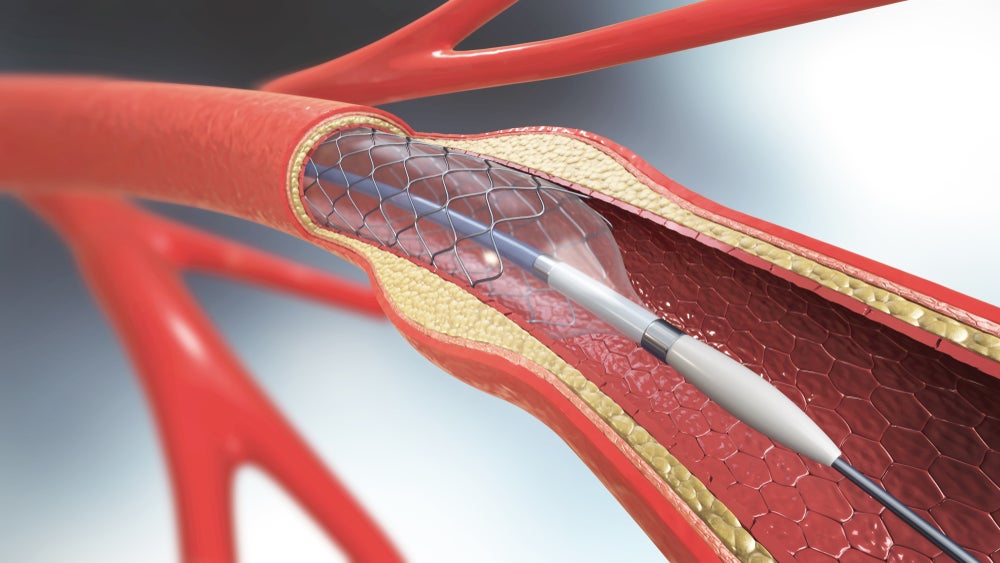
Nitinol, an alloy of nickel and titanium, behaves like a metal with a memory: it can be bent or squeezed through a tiny tube yet once it warms or is unloaded inside the body, it snaps back to a programmed shape. That ability to change form predictably makes Nitinol suitable for medical devices that must be delivered minimally invasively and perform reliably in tight, delicate spaces.
Discovered in the 1960s at the US Naval Ordnance Laboratory, Nitinol’s ability comes from a reversible crystal-structure change between martensite (soft, easily deformed) and austenite (rigid, shape-recovering). Early research focused on mastering composition, heat treatments and finishing so that implants would not fail or release harmful nickel. Over decades, engineers then learned how to laser-cut stents, micro-machine tiny springs and polish surfaces to meet clinical standards.
Go deeper with GlobalData


Access deeper industry intelligence
Experience unmatched clarity with a single platform that combines unique data, AI, and human expertise.
Today Nitinol is everywhere in medicine: in self-expanding vascular stents that open clogged arteries, in guidewires and catheters that snake through vessels, in occluders that close heart defects and in orthodontic wires that apply constant gentle force. Its superelasticity reduces trauma during delivery and improves device conformity to moving anatomy. Advances in manufacturing, surface coatings and biocompatibility testing have cut complications and broadened use, making many procedures less invasive and more accessible.
Looking ahead, it is anticipated that Nitinol devices will become smarter and more durable. Improvements in alloying and processing aim to extend fatigue life and reduce corrosion, while novel coatings will limit nickel exposure and encourage tissue integration. Researchers are developing Nitinol micro-actuators, temperature-tuned implants and hybrid devices that combine sensing and actuation. Better modelling and quality control will also push more personalised device designs. Nitinol’s flexibility, memory and strength can reshape how clinicians treat disease — enabling smaller incisions, faster recovery and devices that adapt inside the body. As materials science and device engineering advance, it is anticipated that Nitinol will continue to be a key tool in making medicine less invasive and more responsive to patients’ needs.

