
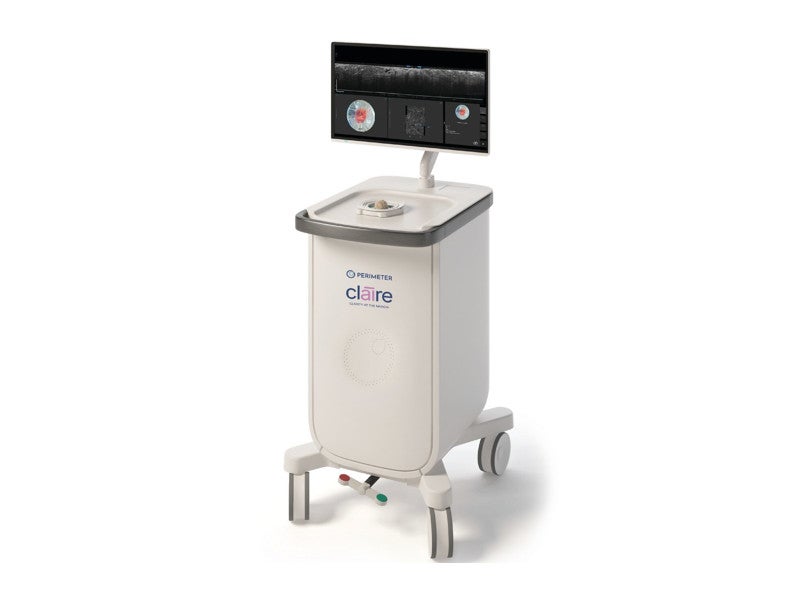
The Claire™ OCT System, previously known as the Perimeter Optical Coherence Tomography (OCT) B-Series with ImgAssist AI 2.0, is the first AI-enabled imaging system approved in the US for intraoperative assessment of breast cancer margins.
Developed by Perimeter Medical Imaging AI, the system is intended to support surgeons in identifying cancerous tissue that may be difficult to visualise during breast-conserving surgery, with the aim of lowering the likelihood of subsequent surgical procedures.
Recommended Buyers Guides

Claire OCT is designed for use alongside established techniques for assessing the margins of excised lumpectomy specimens during operations in patients with biopsy-confirmed breast cancer.
Regulatory approvals for Claire OCT System
Perimeter filed the premarket approval (PMA) application for the Claire OCT System with the US Food and Drug Administration (FDA) in March 2025 and secured a formal FDA PMA in March 2026.
As part of the PMA, the FDA authorised a pre-determined change control plan (PCCP), outlining proposed future AI-related updates that may be introduced without additional FDA review.
The US FDA granted the system a breakthrough device designation in April 2021.
Claire OCT System details
The Claire OCT System is a non-invasive three-dimensional imaging solution that provides real-time, volumetric cross-sectional visualisation of tissue.
Claire integrates Perimeter’s proprietary AI with its patented wide‑field OCT technology to highlight focal regions deemed suspicious for breast cancer.
It enables high‑resolution, real‑time assessment of excised tumour margins and is intended to be used alongside clinician interpretation.
Intraoperatively, the system can indicate areas of concern to help surgeons decide whether to excise additional tissue before concluding the procedure.
The system offers image resolution up to ten-times higher than standard X‑ray and ultrasound, at an imaging depth of 2mm, a margin width commonly referenced in breast cancer margin assessment.
Design and features of Claire OCT system
Claire OCT is a stand-alone, cart-mounted system comprising three primary elements: a mobile cart that houses the system hardware and enables transport; a touchscreen monitor for user interaction and image control; and single‑patient consumables used for tissue positioning and imaging.
The system offers a scan acquisition diameter of up to 8.7cm (3.4in) and can handle specimens up to 10cm in diameter. It also supports scanning from any side of the specimen and in any position.
Using near‑infrared light, the device acquires an array of cross‑sectional, wide‑field OCT (WF‑OCT) images (B‑scans). These are reviewed collectively as volumetric WF‑OCT datasets, with a resolution of up to 50 micrometres.
The system’s user interface displays a real-time image of the specimen, enabling users to see precisely where the WF-OCT scan is being captured.
It enables users to view, mark up and adjust widefield OCT images to support the identification of areas of interest that may be indicative of breast cancer.
Claire OCT AI imaging technology details
The Claire device incorporates the ImgAssist software feature, which applies an AI-based algorithm.
The AI model has been trained on Perimeter’s proprietary OCT image library, which includes more than two million images of malignant and non‑malignant tissue.
These images are produced exclusively using Perimeter’s patented OCT imaging engine. Each procedure performed with Claire generates additional data that can be used to further develop and refine the AI component in line with the authorised PCCP.
Perimeter’s OCT technology
Perimeter’s patented wide‑field OCT technology is a non‑invasive optical imaging modality that generates ultra‑high‑resolution images of subsurface tissue structures.
Used in combination with its proprietary image dataset and integrated AI capabilities, the technology is positioned for use in an estimated 300,000 breast cancer surgical procedures each year in the US.
OCT operates on principles broadly analogous to ultrasound but uses light rather than sound waves. It can be applied to visualise tissue microstructures and features such as blood vessels, ducts and glands.
Clinical trials on Claire OCT system
The safety and efficacy of the Claire OCT system were demonstrated in a prospective, multi-centre, randomised, double-arm trial.
The study evaluated the effectiveness of the system in lowering the incidence of positive surgical margins among women with breast cancer undergoing breast‑conserving surgery.
The efficacy findings are underpinned by an assessment of the device’s diagnostic accuracy alongside the impact of using the device to support clinical decision-making.
The results showed that the Claire OCT system demonstrated an 88.1% accuracy in assessing surgical margins and showed a statistically significant decrease in the proportion of patients with cancer remaining after surgery versus standard care on its own.
When clinicians incorporated the device into their decisions, margin-level sensitivity was 61.5% and specificity was 65.8%. By comparison, standard-of-care decisions made without device support delivered 48.7% sensitivity and 72.1% specificity.
Overall, adjunctive use of the device increased sensitivity for identifying residual disease at the margin by 12.8%, while specificity fell by 6.2%.
