
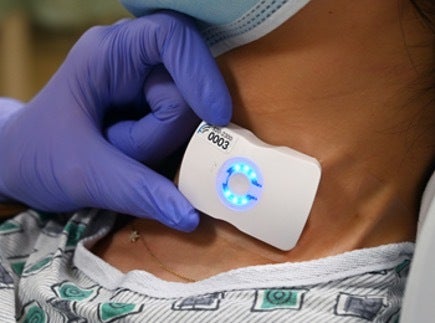
Flosonics has won a contract worth up to $70m from the US Department of Health and Human Services’ (HHS) Biomedical Advanced Research and Development Authority (BARDA) that will see it develop a new AI algorithm for its FloPatch wearable to help clinicians detect internal bleeding after traumatic injury.
US Food and Drug Administration (FDA)-cleared in 2020, Flosonics’ FloPatch is a wearable patch designed to provide ICU clinicians with data on patients’ blood flow to guide intravenous (IV) fluid management and mitigate issues arising from giving too much fluid to patients with conditions such as sepsis.
Go deeper with GlobalData


Discover B2B Marketing That Performs
Combine business intelligence and editorial excellence to reach engaged professionals across 36 leading media platforms.
The centrepiece of the contract involves Flosonics’ development of FloPredict in collaboration with BARDA. The AI algorithm is designed to apply haemodynamic analytics to the doppler signals FloPatch collects.
If successful, the Canadian company highlighted that FloPredict could help clinicians to identify patients at risk of complications from internal haemorrhage who may require urgent intervention.
In trauma and mass casualty settings, where fast and objective information is scarce, that capability could support quicker triage and better use of limited resources, Flosonics added.
Under the BARDA contract, awarded via its Burn and Blast Medical Countermeasures programme, Flosonics will receive initial funding of around $15m to develop the new AI algorithm, with a total potential value of up to approximately $70m if all options under the contract’s terms are exercised.
Joe Eibl, CEO and co-founder of Flosonics Medical, commented: “Partnering with the US government on a capability of this importance is a milestone for Flosonics.
“There is a real gap in how clinicians detect internal bleeding in the critical minutes after injury, and this award lets us build toward closing it. It also reflects the broader potential of FloPatch: the same real-time assessment clinicians rely on in critical care today can be extended to the settings where fast answers matter most.”
Flosonic’s CMO, Jon-Emile Kenny, added that the goal of the federal contract is to create a software that “recognises haemodynamic patterns preceding deterioration from haemorrhage” and surfaces them early enough to act on.
Flosonics’ BARDA contract was announced on 1 September alongside medical technology accelerator MedTech Innovator’s (MTI) announcement that it had been selected as the Diagnostics and Medical Devices Hub of the BARDA Accelerator Network (BAN).
The development means that MTI’s BAN Diagnostics and Medical Devices Hub, known as MedTech Innovator Vantage, is one of five strategic BAN hubs that will focus on advancing next-generation diagnostic and medical device technologies to strengthen the diagnosis of health security threats and response to public health emergencies.


