
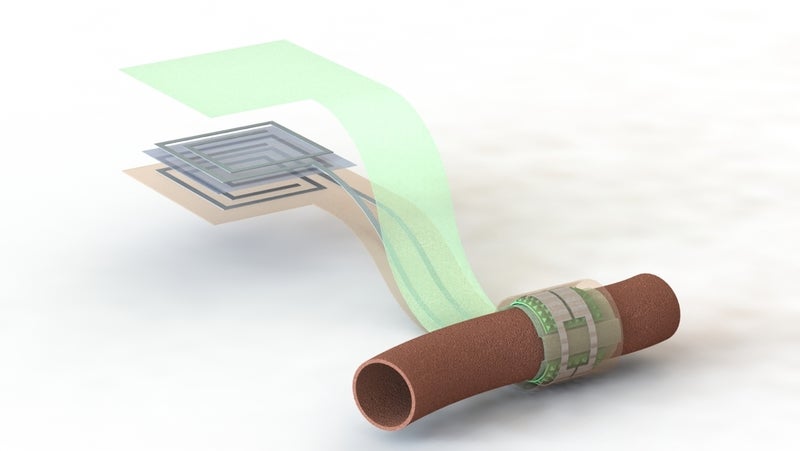
A research team at Stanford University has developed a new biodegradable, battery-free sensor to wirelessly track blood flow following blood vessel surgery.
Intended to monitor the success of the surgery, the blood flow sensor has been designed to warn doctors if a patient has a blockage. The device is expected to allow earlier interventions.
Go deeper with GlobalData


Discover B2B Marketing That Performs
Combine business intelligence and editorial excellence to reach engaged professionals across 36 leading media platforms.
The sensor wraps around the healing blood vessel and could detect any surface changes in the vessel. Doctors will be able to identify the change remotely from a device placed near the skin but outside the body.
Stanford University surgery assistant professor Paige Fox said: “Measurement of blood flow is critical in many medical specialities, so a wireless biodegradable sensor could impact multiple fields, including vascular, transplant, reconstructive and cardiac surgery.”
When tested in rats, the device was able to successfully report blood flow to the wireless reader.
The researchers expect that the sensor’s scope could be expanded from detecting complete blockages to identifying finer fluctuations in blood flow.
Currently, the team is working on devising the best approach to affix the sensor to the blood vessels as well as refining its sensitivity.
In the future, the blood flow sensor could be made available in the form of a stick-on patch or integrated into other technology such as a wearable device or smartphone.
Stanford University School of Engineering professor Zhenan Bao said: “Using sensors to allow a patient to discover problems early on is becoming a trend for precision health.
“It will require people from engineering, from medical school and data people to really work together, and the problems they can address are very exciting.”


